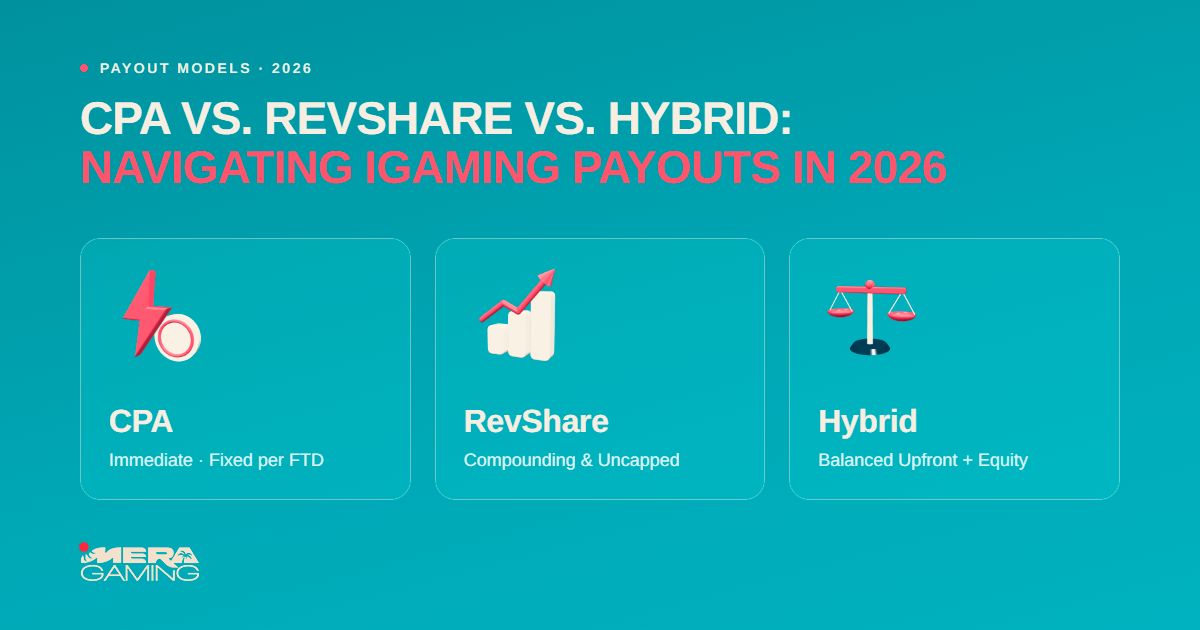
Selecting the right commission structure is the most critical financial decision an iGaming media buyer or webmaster makes when launching a new campaign. Pick the wrong payout model, and you risk suffocating your operational liquidity within weeks—or leaving thousands of euros in long-term player revenue on the table.
Whether you run paid traffic campaigns that demand fast turnover or build search engine authority through long-term SEO, the answer to “which model is best?” is never one-size-fits-all. It depends on your cash flow reserves, traffic channels, target geographies, and business maturity.
In this guide, we break down how CPA, RevShare, and Hybrid deals work, analyzing the pros, cons, and margins of each so you can negotiate the best terms for your affiliate business.
1. Cost Per Acquisition (CPA): Immediate Cash Flow for Fast Scaling
The Cost Per Acquisition (CPA) model is the primary choice for media buyers, PPC specialists, and affiliate teams relying on paid traffic channels such as Meta Ads, Google Ads, Native networks, and private Telegram groups.
How CPA Works
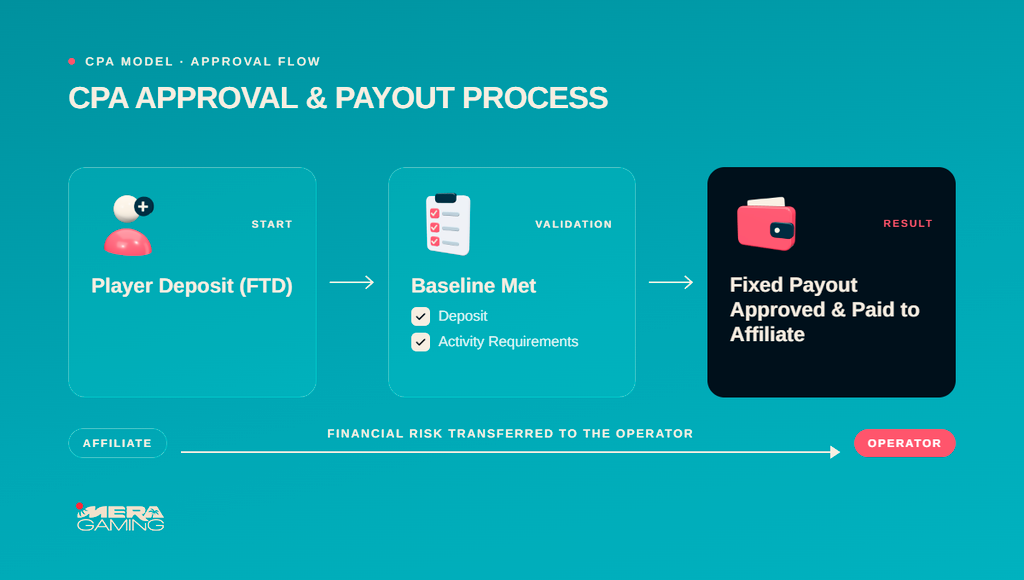
Under a CPA deal, the operator pays a fixed one-time fee (payout) for every new user who completes a First Time Deposit (FTD) and meets specified qualifying criteria known as the baseline (for example, a minimum initial deposit of €10 paired with genuine wagering activity).
Advantages of CPA
- Fast Cash Flow: Returns are realized days or weeks after player acquisition, allowing media buyers to reinvest capital quickly into active campaigns.
- Zero Player Risk: If a player wins a jackpot, the operator absorbs 100% of the financial liability. Your fixed payout remains guaranteed.
- Simple Financial Modeling: Calculating Return on Ad Spend (ROAS) is straightforward. If your cost per FTD on paid channels is €35 and your CPA deal pays €100, your net margin per conversion is clearly defined.
Disadvantages of CPA
- Capped Earnings: If you refer a high-roller (whale) who generates €20,000 in Net Gaming Revenue (NGR), your earning remains capped at your agreed fixed payout (e.g., €120).
- Strict Quality Audits: Operators closely monitor player retention. Traffic sources delivering low-engagement users risk pauses or rejected payouts.
2. Revenue Share (RevShare): Building a Long-Term Passive Asset
The Revenue Share model is the traditional structure favored by SEO webmasters, casino review portals, and content creators building authority sites with organic traffic.
How RevShare Works
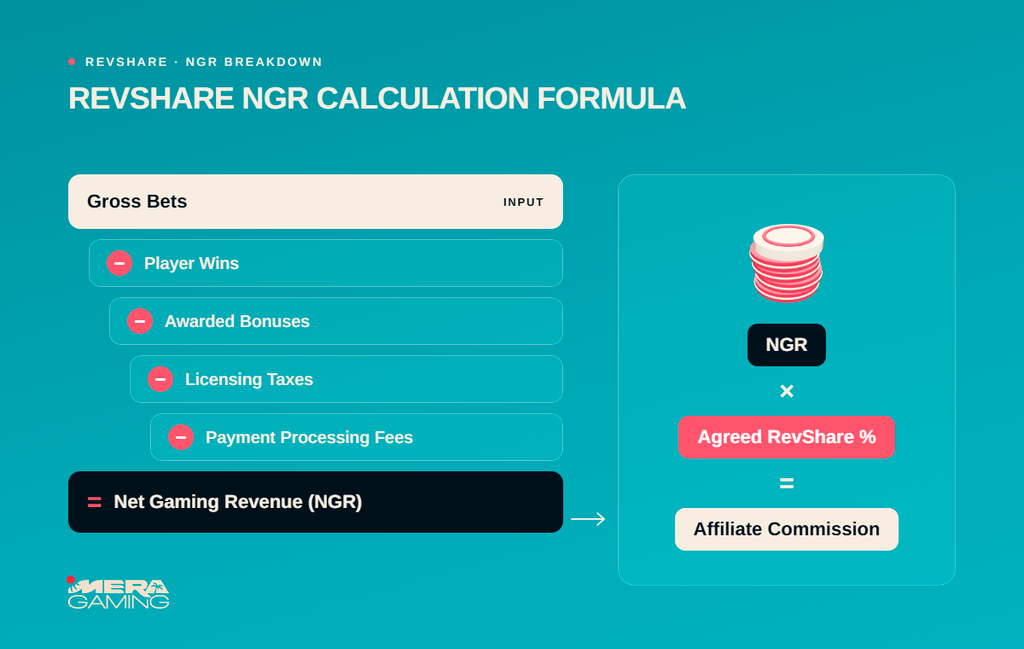
Instead of a single lump-sum payment at registration, the affiliate earns an ongoing percentage of the Net Gaming Revenue (NGR) generated by the player throughout their lifetime on the platform. NGR is calculated by subtracting player wins, awarded bonuses, licensing taxes, and payment processing fees from the gross gaming revenue.
Advantages of RevShare
- Compounding Passive Revenue: A portfolio of active players built over several years creates recurring revenue with minimal daily maintenance costs.
- Uncapped High-Roller Upside: A single dedicated player can dramatically increase your monthly payout.
- Aligned Interests: Operators invest heavily in CRM and retention strategies to keep players active, directly extending your earning lifetime value (LTV).
Disadvantages of RevShare
- Delayed Payback Period: It typically takes 3 to 6 months for cumulative RevShare earnings to equal what a single CPA payout would have yielded upfront.
- Negative Carryover Risk: If an active player hits a large winning streak in a given month, your account revenue goes into the negative. Unless your agreement includes a No Negative Carryover clause, that deficit carries over to offset future earnings.
3. Hybrid Deals: Balancing Upfront Cash and Long-Term Value
The Hybrid Model combines elements of CPA and RevShare into a single contract. It is designed for established affiliates with proven traffic quality who require operational liquidity alongside long-term equity.
How Hybrid Works
In a Hybrid deal, the affiliate receives a lower fixed CPA per FTD combined with a modest lifetime RevShare percentage.
- Example Hybrid Term: €50 CPA per qualifying FTD + 20% Lifetime RevShare.
When to Choose a Hybrid Model
A Hybrid deal works best when you need immediate cash flow to cover daily operational expenses (such as content creation, media costs, or software tools) while retaining long-term revenue share from high-value players.
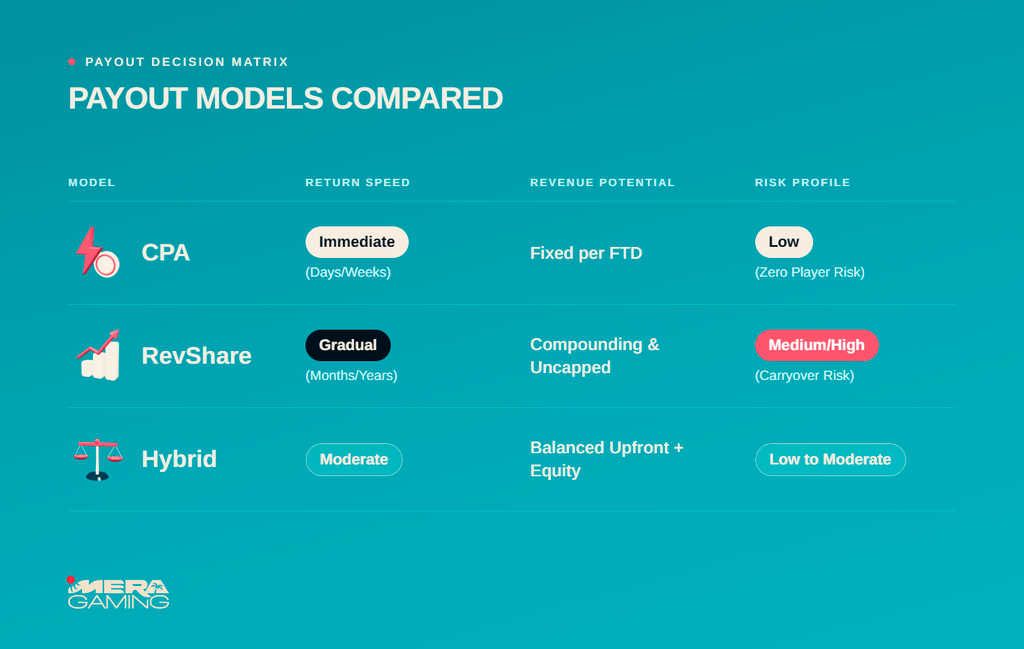
| Commission Model | Ideal Target Profile | Return Velocity | Revenue Potential | Risk Profile |
| CPA | Media Buyers, Paid Search, Social Ads | Immediate (Days/Weeks) | Fixed per conversion | Low |
| RevShare | SEO Sites, Review Portals, Streaming | Gradual (Months/Years) | Compounding / Uncapped | Medium/High (Negative Carryover) |
| Hybrid | Mixed Media Teams, Scaling Affiliates | Moderate | Balanced / Long-term | Low/Medium |
4. Decision Matrix: How to Choose the Right Model
To select the right commission structure for your operations, evaluate your business against three key factors:
A. Traffic Source & Acquisition Cost
If you buy paid media on real-time bidding platforms, your expenses are immediate and recurring. In this setup, CPA provides the fast liquidity needed to maintain daily ad spend. If your traffic flows organically via search engines (Google, Bing) or private communities (Telegram, YouTube), RevShare or Hybrid deals offer higher total earnings over time.
B. Geographic Market (GEO Tiers)
- Tier 1 Markets (e.g., UK, Nordics, Germany): High player acquisition costs are balanced by higher Lifetime Value (LTV). In these regions, RevShare or Hybrid terms yield solid long-term margins.
- Tier 3 / LatAm Markets (e.g., Brazil, Peru, Colombia): High-volume markets with rapid conversion rates benefit from CPA terms, allowing affiliates to scale FTD volume quickly and recycle capital efficiently.
C. Cash Flow Reserves
Avoid pure RevShare deals if your business lacks sufficient working capital to cover operational expenses during the initial 60 to 90 days of a new campaign.
5. Negotiating Transparent Terms with Your Affiliate Network
Commission terms should evolve alongside your traffic volume and retention metrics. When reviewing proposals with your Affiliate Manager, evaluate these critical operational clauses:
- Baseline Clarity: Ensure deposit thresholds and activity triggers are explicitly defined. High CPA payouts with restrictive baselines can result in lower overall conversion rates than moderate payouts with accessible conditions.
- Negative Carryover Policies: Confirm whether your network offers No Negative Carryover protection to prevent player wins from penalizing future earnings.
- Payment Frequency: Reliable weekly or bi-weekly payouts are often more valuable for operational scaling than higher monthly payouts with long lag times.
At MERA GAMING, we partner directly with affiliates and operators to structure flexible B2B agreements. As an iGaming affiliate network connecting traffic to global brands, we evaluate traffic sources individually to offer tailored CPA, RevShare, and Hybrid models that align with your cash flow needs.
For deeper insights, check out our recent analysis of the LatAm iGaming regulatory landscape or our overview on ecosystem-led growth model on our blog. For external regulatory standards and market guidelines, refer to official updates from the European Gaming and Betting Association (EGBA).
Ready to Scale Your Campaigns with Flexible Commission Terms?
Whether you are scaling paid campaigns in high-volume GEOs or looking to transition your SEO traffic into a hybrid deal, our team provides dedicated account management and transparent tracking to support your growth.
To access our high-converting offers, real-time analytics, and customized commission structures tailored to your traffic profile:
Do you have any specific volume requirements? Reach out to our team and discuss directly custom CPA and Hybrid terms for your active campaigns.