South America iGaming Market 2026: SiGMA Report Insights
The South America iGaming market 2026 has moved far beyond cheap click volume. Specifically, the new SiGMA South America Market Report 2026 confirms that the region is now in a phase of steady growth. Authored by Jenny Ortiz-Bolivar with Blask data from February 2025 to January 2026, the study proves that Brazil drives the entire continent.
Furthermore, the report connects search demand, monthly revenue, and direct warnings from local executives. For B2B operators and affiliates, these insights are vital. As a result, teams can use this data to plan media budgets, structure CPA or RevShare deals, and protect profit margins.
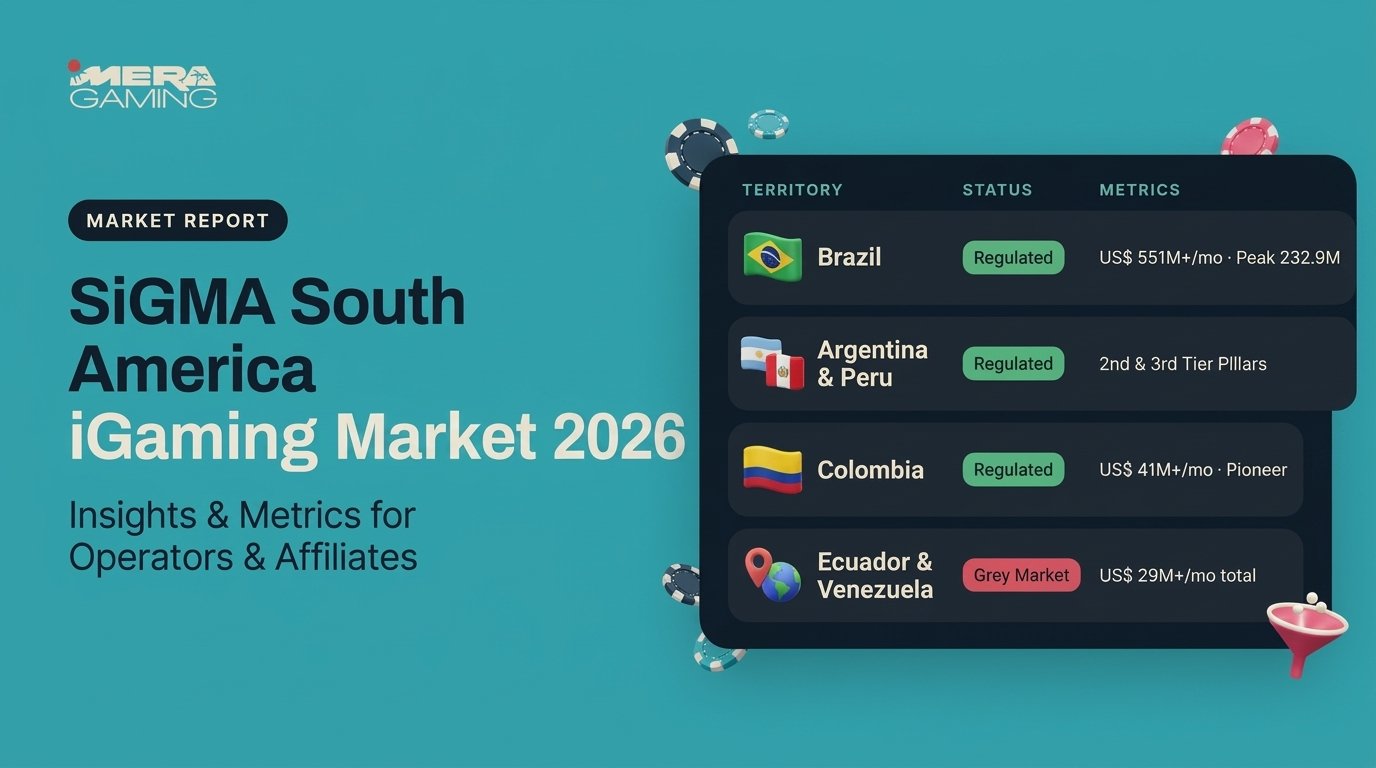
- Brazil leads by a wide margin: First, Brazil hit a peak of 232.9 million on the Blask Index. Its estimated monthly revenue also topped US\$ 551 million.
- Clear rules drive higher revenue: Most measurable revenue comes from regulated countries. Specifically, Brazil, Argentina, Peru, and Colombia lead this group.
- Second-tier markets now have real scale: Meanwhile, Argentina and Peru form the second major revenue hub. Colombia also maintains steady volume above US\$ 41 million per month.
- Unregulated demand remains active: In contrast, unregulated markets still generate strong offshore revenue. For example, Ecuador reaches US\$ 19 million per month, while Venezuela tops US\$ 10 million.
- High taxes threaten legal growth: Finally, industry leaders warn against heavy tax rates and slow sign-ups. Otherwise, players will return to unlicensed sites.
1. Brazil as the Structural Anchor of the Continent
In the joint SiGMA and Blask study, Brazil stands in a league of its own. The country has over 220 million people and more than 170 million internet users. Moreover, its instant payment system (PIX) makes deposits effortless. Consequently, Brazil turns brand interest into gaming revenue faster than any other market in Latin America.
According to Carlos Cardama, a veteran gaming leader linked to Fecoljuegos and FIJA, Brazil now sets the operational standard for the region. Specifically, it leads across three core areas: legal compliance, product localization, and market-entry strategy.
In practice, Brazilian players expect fast mobile apps, instant payouts, local support, and clear bonus terms. Therefore, these high user standards have raised the competitive bar across all of South America.
2. The Regional Map: Regulated Markets vs. Grey Markets
The SiGMA report also offers a clear breakdown of mature regulated markets versus transitional ones. As a result, teams managing multi-GEO campaigns can spot the best growth opportunities right away.
| Country / Bloc | Regulatory Status | Engagement & Revenue (Blask Data) | Strategic Takeaway |
|---|---|---|---|
| Brazil | Regulated | Peak of 232.9M on Blask Index; over US\$ 551M/month in estimated revenue. | Anchor market; requires strong compliance, retention, and qualified traffic. |
| Argentina & Peru | Regulated | Form the 2nd and 3rd pillars of demand and revenue in South America. | Structured growth with fast entry from top global operators. |
| Colombia | Regulated (Pioneer) | Engagement peak above 14M; monthly revenue exceeding US\$ 41M/month. | Mature legal market, though sensitive to sudden tax policy changes. |
| Chile | Pending Full Online Law | High revenue relative to total population size. | Strong player demand via global brands while awaiting final laws. |
| Ecuador & Venezuela | Unregulated (Grey / Offshore) | Ecuador near US\$ 19M/month; Venezuela above US\$ 10M/month. | Active organic demand, paired with tax and player safety challenges. |
Overall, the report’s authors reach a simple conclusion: legal clarity and revenue scale move together. While offshore volume exists in grey markets, long-term stability lives in regulated countries. Consequently, serious brands and affiliates focus their budgets where clear rules protect partnerships.
3. What Industry Leaders Say: Tax Pressure, Friction, and the 5-Year Outlook
Blask data shows where the money flows today. Meanwhile, SiGMA’s executive interviews explain why the market behaves this way—and highlight key risks ahead.
The Danger of Heavy Tax Hikes
Carlos Cardama warns governments against imposing steep taxes on licensed operators. When lawmakers treat iGaming solely as a quick tax source, legal brands suffer. Specifically, higher taxes force operators to offer worse odds, smaller bonuses, or strict sign-up checks. As a result, frustrated players quickly move back to illegal offshore sites.
Furthermore, other industry leaders in the report echo this concern. Today’s Latin American bettor expects instant deposits and smooth mobile play. Therefore, slow withdrawals or complex KYC steps immediately hurt conversion rates.
Pragmatic Optimism for the Next Five Years
At the same time, Ahikam Raviv, CCO at Notix Games, shares an upbeat view on the region’s long-term future:
“I strongly believe in South American resilience,