In today’s hyper-competitive digital gambling market, standard optimization tactics no longer cut it. Publishing basic reviews and acquiring generic backlinks will not secure long-term organic visibility. The iGaming industry is high-stakes and unforgiving. Google scrutinizes websites under strict Your Money Your Life (YMYL) standards, while operators must navigate complex local compliance, heavy dynamic rendering requirements, and aggressive competitors.
Key Takeaways: iGaming Technical SEO Summary
| Technical Focus Area | Primary Risk / Challenge | Optimized Solution |
|---|---|---|
| JS Rendering Engine | CSR causes indexing delays for time-sensitive offers and dynamic odds. | Implement Server-Side Rendering (SSR) or Incremental Static Regeneration (ISR) via Next.js. |
| Faceted Navigation | Parameter explosion drains crawl budget on low-value URLs. | Apply noindex, follow or robots.txt blocks to zero-search parameters; use self-referential canonicals on pagination. |
| Mobile Core Web Vitals | Embedded slot iFrames ruin LCP and Total Blocking Time (TBT). | Deploy a Facade Pattern (static thumbnail requiring user interaction before mounting the iFrame). |
| Geo-IP Routing | Automatic 302 redirects trap Googlebot in redirect loops. | Bypass GeoIP logic for verified crawlers via WAF/Nginx rules; use non-intrusive recommendation banners for users. |
| Hreflang Architecture | Missing reciprocity or non-canonical targets invalidates international targeting. | Ensure 100% reciprocal links, canonical targets only (200 OK), and set an x-default global fallback. |
| Edge Computing & Security | Manual region management causes CLS; link spam threatens domain authority. | Inject dynamic GEO offers at the Edge (Cloudflare Workers); enforce WAF protection and active GSC crawl audits. |
Whether managing acquisition for an online casino or overseeing a high-volume affiliate portfolio, prioritizing your technical foundation is essential; in fact, it forms your primary competitive edge. A tiny flaw in JavaScript rendering, a misplaced canonical tag on paginated category pages, or a broken Geo-IP redirect loop can silently destroy your search rankings overnight.
Mastering technical SEO iGaming architecture is the core requirement to survive algorithm updates and capture high-intent search traffic. Paired with precise geo targeting casino affiliates strategies, you ensure every visitor lands on licensed, compliant, and high-converting offers.
1. Understanding the Complex iGaming Search Landscape
Search engine results pages (SERPs) in the gambling space are split into two primary segments: Operators and Affiliates.
- Operators run the actual casino or sportsbook platforms, handling payment processing, player accounts, dynamic odds feeds, and strict multi-jurisdictional compliance engines.
- Affiliates act as content hubs and review portals, capturing high-intent search traffic and routing qualified players to operators.
Both segments deal with extreme SERP volatility. Google regularly deploys Core and Spam updates targeting financial and gambling queries. In iGaming, a technical flaw during an update can wipe out half your organic visibility in days because algorithms continuously refine how they grade regulatory compliance, performance, and topical trust.
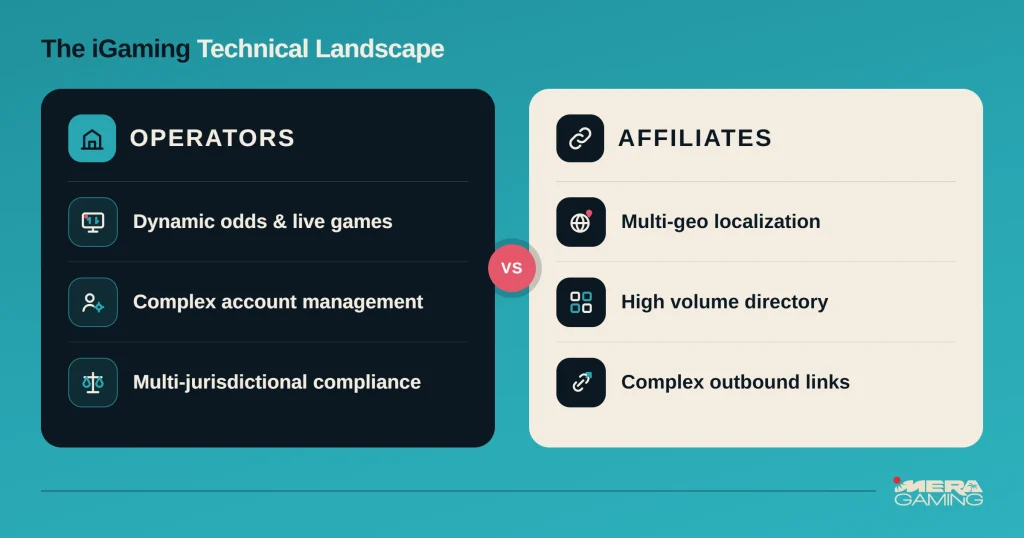
Regulatory compliance adds unmatched technical complexity. Gambling laws vary by state, province, or country, from iGaming Ontario in Canada to strict UKGC rules in the UK or SRIJ compliance in Portugal. Your technical architecture must segment and deliver localized content, dynamic offers, and legal disclaimers without creating duplicate content traps or wasting crawl budget.
2. Advanced Technical Architecture & Rendering Engineering for Technical SEO iGaming
Removing the Client-Side Rendering Trap
Modern platforms often use headless architectures (React, Vue, Next.js) for speed and interactivity. However, relying on pure Client-Side Rendering (CSR) is extremely risky; consequently, it can negatively impact both crawlability and performance.
When crawlers land on a pure CSR page, they encounter bare HTML and script tags. Googlebot must queue the page for a secondary rendering pass where a headless browser executes JavaScript to construct the DOM.
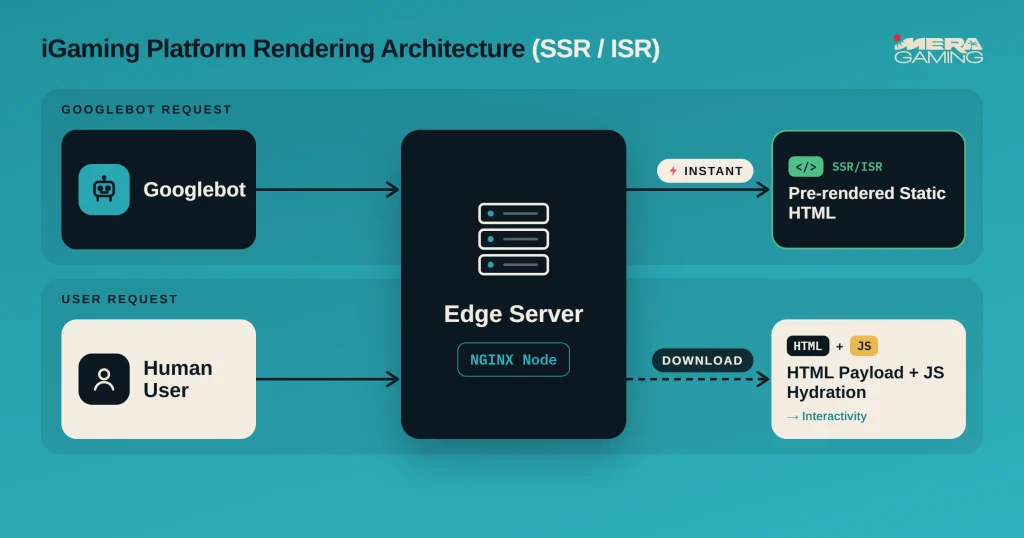
In iGaming (where bonus offers change daily and new slot reviews go live constantly), waiting days or weeks for secondary rendering is unacceptable.
The Solution: Implement Server-Side Rendering (SSR) or Incremental Static Regeneration (ISR). With frameworks like Next.js, pre-render static HTML at the edge. When a crawler requests a page, the edge server delivers fully rendered HTML on the first byte (TTFB). When a human visitor opens the page, client-side JavaScript hydrates the layout seamlessly.
Optimizing Crawl Budget Across Faceted Systems
Affiliate portals frequently accumulate thousands of low-value URLs. This is primarily due to faceted search filters (provider, theme, paylines, bet limits), internal search pages, as well as affiliate link tracking parameters
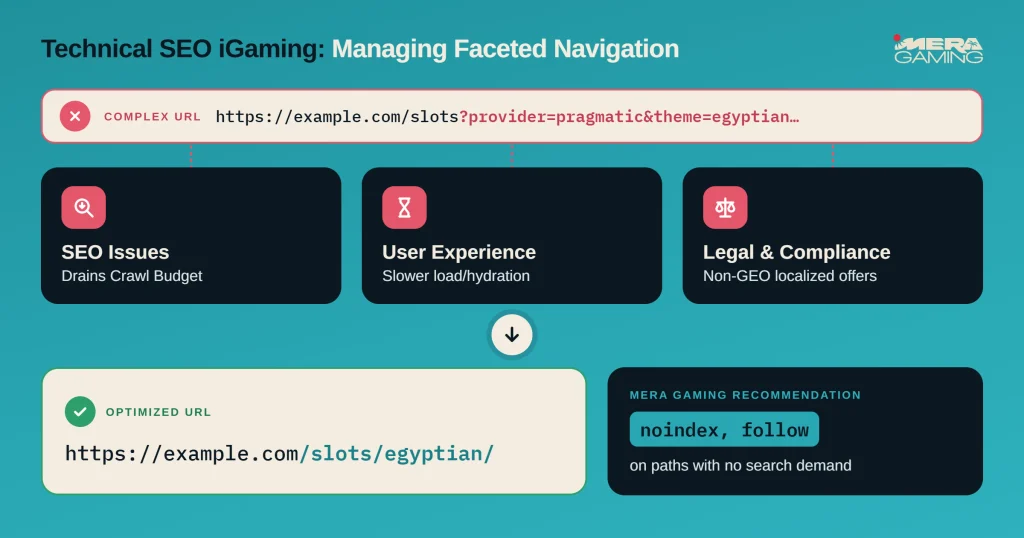
- Audit Parameters: Identify filter combinations without verified search volume. Apply noindex, follow tags or block them via robots.txt.
- Canonical Hygiene: Implement self-referential canonical tags whenever parameter pages target distinct search intent. On the other hand, non-essential filter variations should canonicalize back to the parent category page, thereby preventing index bloat
- Fix Pagination canonicals: Never canonicalize deep paginated pages (/casinos/page/2/) back to the root category page (/casinos/). Doing so signals that deep pages are duplicates; as a result, Googlebot stops crawling deeper links and starves inner review pages of internal PageRank. Therefore, you should use self-referential canonicals across all paginated URLs.
Core Web Vitals & Mobile Performance Engineering
Mobile devices generate most iGaming traffic. However, embedded game demo iFrames execute heavy third-party scripts upon initial load; consequently, this severely impairs key performance metrics such as Largest Contentful Paint (LCP) and Total Blocking Time (TBT).
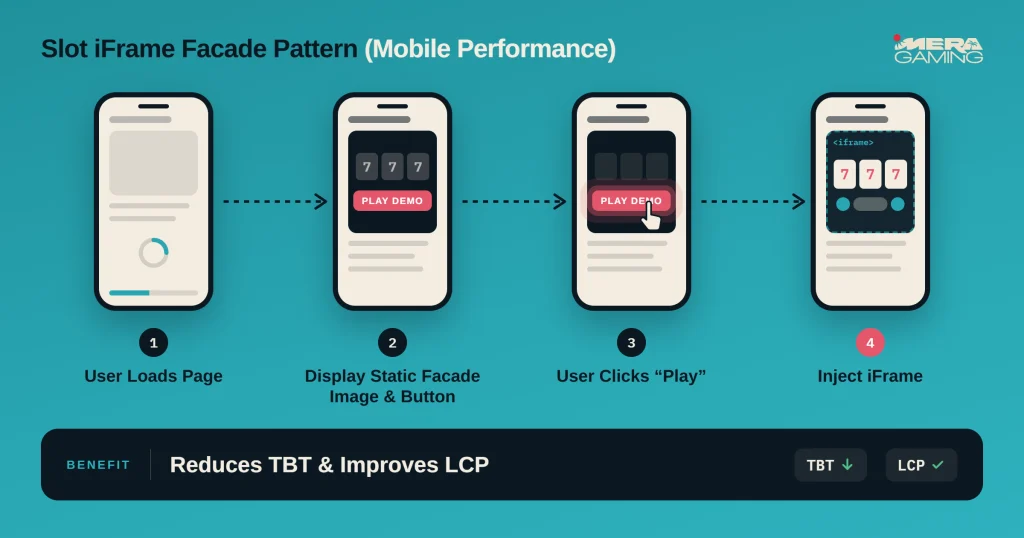
The Facade Pattern: Instead of loading live iFrames immediately, display a static thumbnail with a “Play Demo” button overlay. Request and inject the actual iFrame into the DOM only when the user explicitly clicks the button.
Additionally, non-essential third-party analytics and tracking tags should be deferred via edge middleware or script loaders. As a result, the main thread remains unblocked during initial viewport rendering.
3. Mastering Geo Targeting Casino Affiliates & Architectural Routing
In international affiliate marketing, non-localized traffic translates directly to wasted revenue. Specifically, directing a UK visitor to an operator that only accepts Brazilian players not only destroys your conversion rate, but also undermines domain trust.
Evaluating Domain Architectures for International Geo Targeting
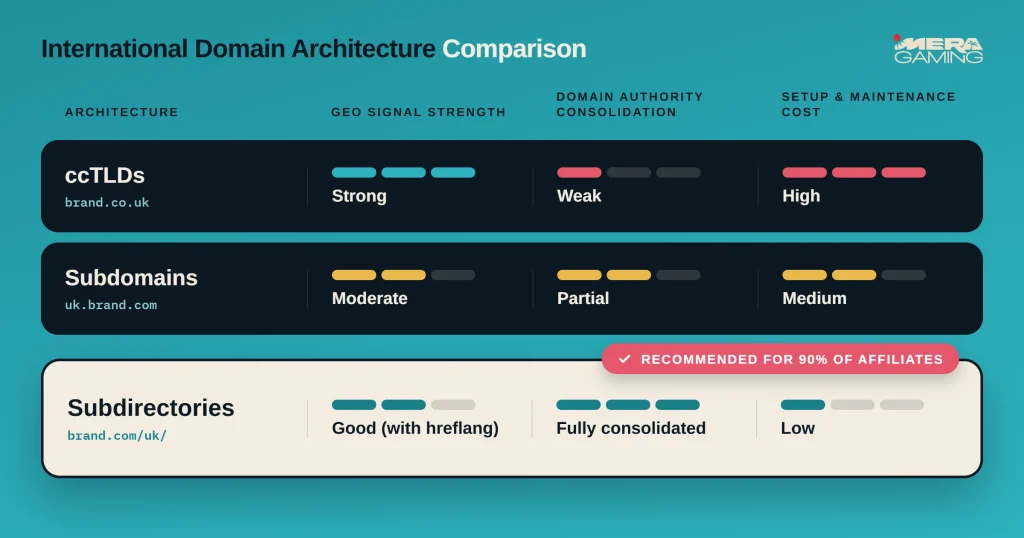
| URL Structure | GEO Signal Strength | Domain Authority Consolidation | Setup & Maintenance Cost | MERA Gaming Recommendation |
|---|---|---|---|---|
| ccTLDs (e.g., brand.co.uk) |
★★★★★ (Maximum) | Split Authority | High Cost | Mature, High-Volume Markets Only |
| Subdomains (e.g., uk.brand.com) |
★★★★☆ (Strong) | Partial Consolidation | Medium Cost | Large-scale localized operations |
| Subdirectories (e.g., brand.com/uk/) |
★★★★☆ (Strong)* | ★★★★★ (Total) | ★★★★★ (Low) | RECOMMENDED FOR 90% OF AFFILIATES |
*Requires strict Hreflang implementation to pass consolidation signals cleanly.
Subdirectories on a single main domain (gTLD) consolidate all backlink authority onto the root domain, allowing new localized pages to rank much faster than unranked ccTLDs.
Resolving the GeoIP Redirection & Googlebot Crawling Loop
Automated GeoIP redirects at the root level create severe indexing issues. Googlebot primarily crawls from United States IP addresses. If your server executes an automatic 302 redirect for US visitors, Googlebot gets trapped in a permanent redirect loop to /us/, preventing it from discovering or indexing regional subdirectories like /uk/, /ca/, /br/, or /de/.
Step 1: Implement Crawler Bypasses at the Server Layer
Configure your Web Application Firewall (WAF), NGINX server, or Edge Workers to bypass GeoIP redirection logic when a request originates from a verified search engine crawler.
Here is a conceptual NGINX configuration demonstrating how to separate automated bot traffic from human visitor redirection paths:
# Map User-Agent strings to identify search engine crawlers
map $http_user_agent $is_search_crawler {
default 0;
“~*Googlebot” 1;
“~*bingbot” 1;
“~*DuckDuckBot” 1;
“~*YandexBot” 1;
}
server {
listen 443 ssl http2;
server_name brand.com;
location / {
# Execute IP geolocation lookup for human visitors only
if ($is_search_crawler = 0) {
# Route human visitors based on IP database lookups
# Example: Send Spanish IPs to /es/ directory
rewrite ^/$ /es/ redirect;
}
# Serve default root homepage content to search crawlers without redirection
try_files $uri $uri/ /index.php?$args;
}
}
Step 2: Use Non-Intrusive GEO Recommendation Banners
Replace forced redirects for human visitors with a dynamic banner at the top of the viewport: “We noticed you are visiting from Brazil. For example, asking, ‘Would you like to view our localized Brazilian casino guide?‘ gives users full control. At the same time, this approach allows search crawlers to index every localized folder across your network.
Implementing Bulletproof Hreflang Architecture
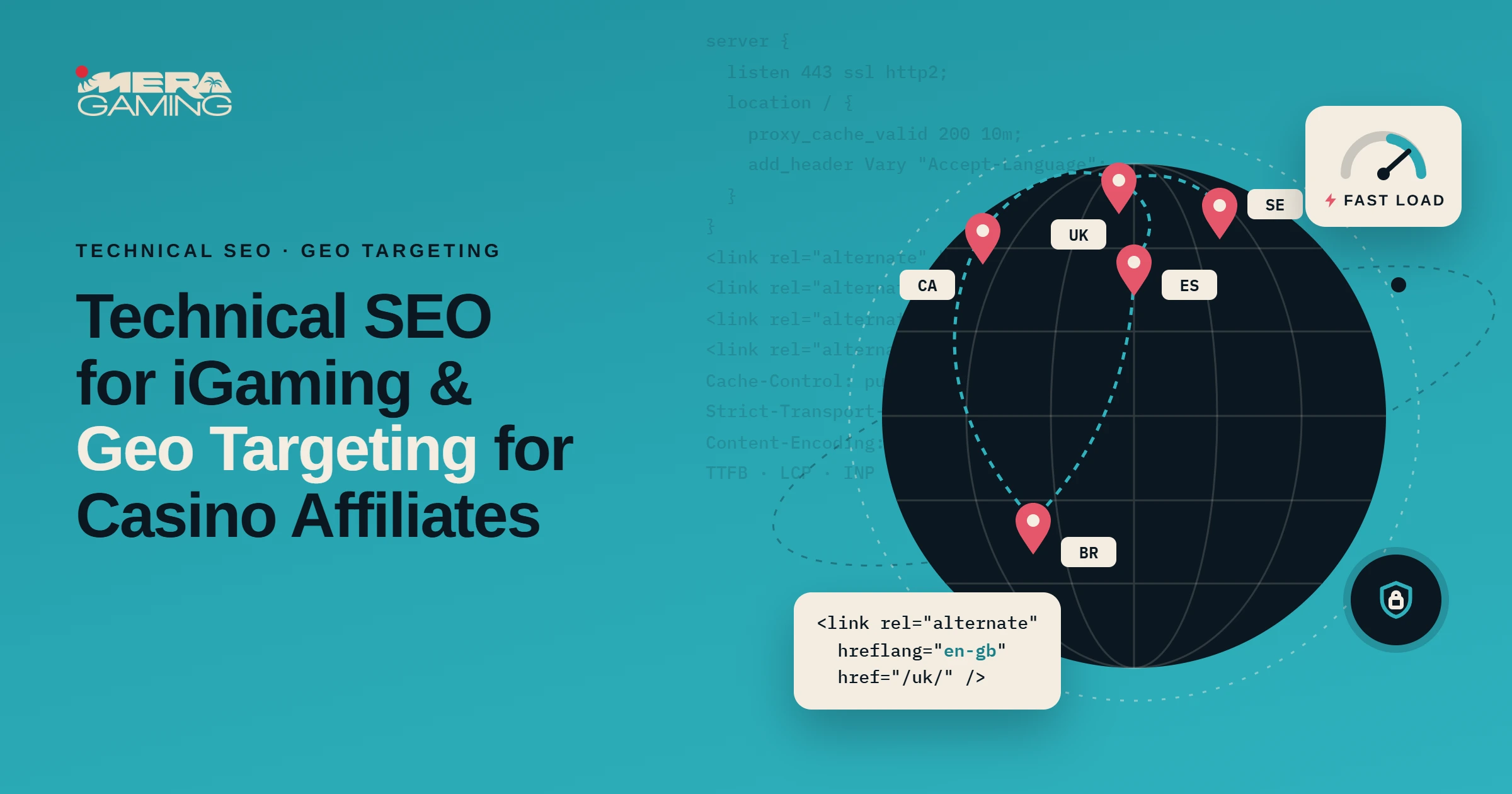
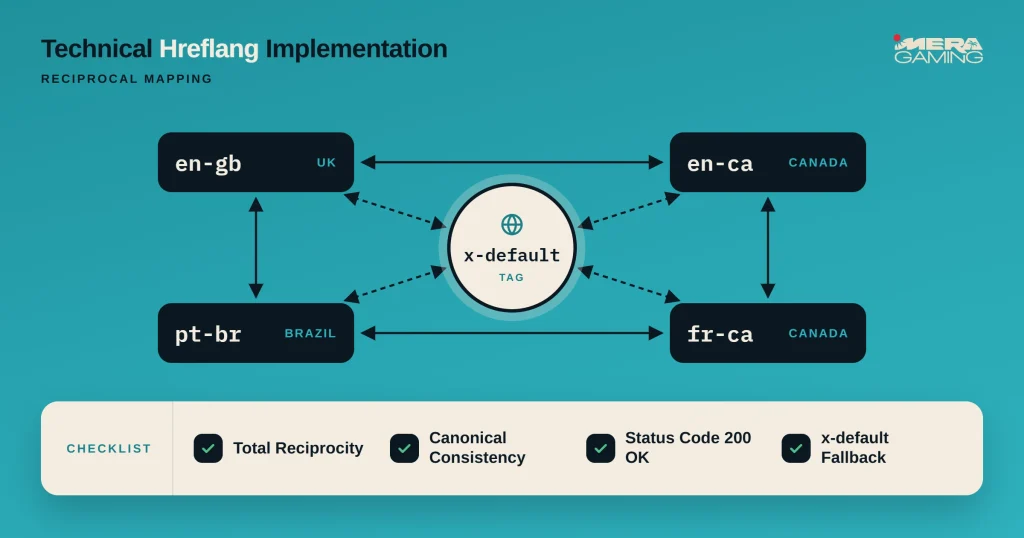
To route searchers to the correct language and regional URL, add reciprocal meta tags inside the <head> of every localized variant:
<!– Reciprocal Hreflang Annotations for International Subdirectories –>
<link rel=”alternate” hreflang=”en-gb” href=”https://brand.com/uk/casinos/” />
<link rel=”alternate” hreflang=”en-ca” href=”https://brand.com/ca/casinos/” />
<link rel=”alternate” hreflang=”fr-ca” href=”https://brand.com/ca-fr/casinos/” />
<link rel=”alternate” hreflang=”pt-br” href=”https://brand.com/br/casinos/” />
<link rel=”alternate” hreflang=”es-es” href=”https://brand.com/es/casinos/” />
<!– Global Fallback Target for Unmapped Regions –>
<link rel=”alternate” hreflang=”x-default” href=”https://brand.com/casinos/” />
3 Essential Hreflang Compliance Rules:
- Absolute Reciprocity: If the /uk/ page links to /ca/, in turn, the /ca/ page must provide a reciprocal link pointing back to /uk/. A single missing link invalidates the cluster.
- Canonical Target Consistency: Hreflang tags must point exclusively to indexable canonical URLs returning 200 OK HTTP status codes.
- The x-default Fallback: Always define an x-default target for users whose geographical location or language settings do not match any specified regional codes.
Edge-Side Dynamic Content & Regulatory Disclaimers
Managing localized offers, currency symbols, and legal disclaimers across thousands of reviews can overwhelm editorial teams.
Modern technical SEO iGaming setups leverage Edge Computing (such as Cloudflare Workers or Fastly Compute@Edge) to inject localized elements into the static HTML stream before it reaches the browser. Specifically, Edge Workers analyze client request headers to detect country codes. As a result, they can dynamically insert correct local currency symbols (€, £, R, CAD), active bonus offers, and furthermore, display mandatory regulatory disclaimers like UKGC 18+ BeGambleAware banners or Portuguese SRIJ license details.
This eliminates Cumulative Layout Shift (CLS) caused by slow client-side scripts; furthermore, it protects your domain against regulatory blacklisting as well as DNS blocks imposed by national telecommunications authorities..
4. Hardening Security, Preserving Index Equity, and Defending Against Negative SEO
High commercial margins make iGaming portals prime targets for negative SEO attacks, malicious scraping, and security exploits.
Defending Against Attacks and Unauthorized Code
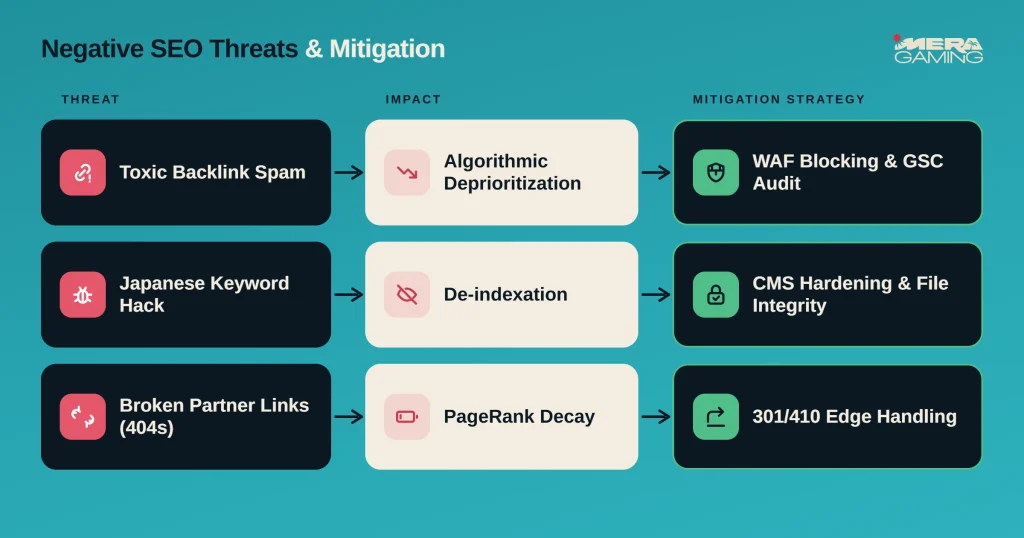
- Deploy a Web Application Firewall (WAF): Use enterprise WAF protection (Cloudflare, Sucuri, AWS Shield) with strict rate-limiting rules to block malicious botnets and brute-force attempts on administrative endpoints.
- Monitor Crawl Behavior Daily: Track indexed page counts in Google Search Console. Sudden spikes in indexed URLs or foreign query keywords often signal CMS exploits like the Japanese Keyword Hack. Isolate infected files immediately and return 410 Gone HTTP headers for unauthorized URLs.
- Routine Backlink Audits: Monitor your backlink profile (Ahrefs, Semrush). Proactively disavow large-scale automated link spam campaigns anchored with toxic keywords.
Managing Defunct Partner Links & PageRank Equity
When a casino operator closes down or suspends an affiliate program, it creates dead outbound links. As a result, user trust is damaged and internal PageRank distribution degrades.
- Topical 301 Redirections: If an operator closes in a specific market, set up a 301 redirect from that review page to a closely matching licensed alternative in the same region. By doing so, you preserve acquired link equity while simultaneously routing traffic to active partners.
- Issue a 410 Gone Status: If an operator shuts down permanently with no viable substitute, update the URL header to 410 Gone. This explicitly instructs crawlers to purge the page from the index, saving crawl budget for active content. Avoid redirecting dozens of unrelated dead reviews to your homepage, as Google will flag them as soft 404s.
Frequently Asked Questions (FAQs)
1. Why does Client-Side Rendering (CSR) delay page indexation in iGaming SEO?
Client-Side Rendering forces search crawlers to execute complex JavaScript bundles on their own infrastructure, sending pages into a secondary rendering queue. In fast-moving sectors like iGaming—where casino bonuses, odds, and operator lists update constantly—this delay can keep time-sensitive reviews out of search indexes for weeks. Transitioning to Server-Side Rendering (SSR) or Incremental Static Regeneration (ISR) ensures pre-rendered HTML is delivered instantly on the first byte.
2. How can I prevent GeoIP auto-redirection scripts from blocking Googlebot?
Because Googlebot crawls primarily from US-based IP addresses, automated server-side 302 GeoIP redirects trap crawlers in a loop toward your US page variant, hiding your regional subdirectories (/uk/, /br/, /es/). Configure your server or WAF to bypass GeoIP redirection logic for verified search engine bots, and replace forced user redirects with non-intrusive regional recommendation banners.
3. What is the most effective URL structure for international casino affiliates?
For about 90% of international geo targeting casino affiliates, subdirectories (e.g., brand.com/uk/ or brand.com/br/) offer the best balance. They consolidate all acquired backlink equity onto a single root domain, allowing localized category pages to rank significantly faster and cheaper than launching separate ccTLDs from scratch.
4. How should affiliates manage dynamic slot iFrames without hurting mobile performance?
Loading interactive slot demo iFrames directly during the initial page render ruins Core Web Vitals metrics, specifically Largest Contentful Paint (LCP) and Total Blocking Time (TBT). Implement a Facade pattern: display a lightweight static thumbnail image with a “Play Demo” button overlay on load, and only inject the heavy iFrame script when the user explicitly clicks it.
5. What are the main compliance risks of mismanaging regional disclaimers?
Failing to display mandatory local regulatory disclaimers (such as 18+ age restriction badges, BeGambleAware links, or local licensing references like UKGC or SRIJ) in strictly monitored jurisdictions can lead to administrative domain bans or DNS blocks by national telecommunication authorities, instantly wiping out your organic traffic.
Conquering the SERPs: Build Your Acquisition Engine
Scaling an international acquisition network in iGaming demands a resilient technical architecture built for modern search engine mechanics. By implementing Server-Side Rendering while keeping your crawl budget optimized, you can accelerate mobile performance via facade patterns. At the same time, resolving Geo-IP redirect loops and maintaining reciprocal hreflang configurations thereby creates a dependable foundation for long-term organic growth.
Scale Your iGaming Affiliate Revenue With MERA GAMING
Ready to transform your technical infrastructure into a high-converting acquisition channel? First, explore our platform solutions to see how we scale. Next, review active high-converting regional offers, or simply connect directly with our partnership team to discuss custom commission structures tailored to your growth.