Mastering iGaming affiliate CRO requires far more than persuasive copywriting or high search engine rankings. It demands a frictionless UX/UI architecture and rock-solid casino site authority.
In the hyper-competitive iGaming ecosystem, driving thousands of organic or paid visitors to an affiliate review page is meaningless if slow page speed or high visual cognitive load destroys user intent before they click the registration button.
Therefore, Conversion Rate Optimization (CRO) in iGaming is the technical science of identifying friction points along the player journey and eliminating them to maximize First Time Deposits (FTDs) and Net Gaming Revenue (NGR).
Defining Conversion Rate Optimization (CRO) and Authority in the iGaming Ecosystem
Understanding the mechanics of conversion optimization requires stepping back. We need to analyze the fundamental mechanics of user trust and web performance.
Whether you’re a newcomer building your first casino review portal or an established affiliate network optimizing high-volume media buying campaigns, conversion rates are critical. They are the single most significant factor determining your Average Revenue Per User (ARPU).
This comprehensive guide breaks down the core technical, psychological, and design frameworks required to succeed. You will learn how to transform passive search engine traffic into high-value, long-term players for top-tier operators.
To construct an effective conversion framework, we’ve got to establish clear definitions first. We need to see how performance metrics behave within regulated and non-regulated iGaming verticals.
For an affiliate, a conversion isn’t a single event. It’s a multi-step funnel. It begins right at the Search Engine Results Page (SERP) and extends all the way to player retention and lifetime value
The Conversion Funnel Architecture
The iGaming affiliate conversion funnel operates across three distinct stages:
- Outbound Click-Through Rate (Outbound CTR): The percentage of visitors landing on your affiliate review page who click an outbound link or Call to Action (CTA) button leading to a casino operator.
- Click-to-Register (CTR-to-Reg): The percentage of users who, upon landing on the operator’s registration page, successfully complete the account creation process.
- Register-to-Deposit (Reg-to-FTD): The critical financial conversion metric tracking how many registered users perform their initial real-money deposit, triggering a Cost Per Acquisition (CPA) payout or commencing a Revenue Share baseline.
Affiliates don’t control an operator’s internal onboarding design or payment gateway success rates. Still, their pre-qualification role is paramount. A poorly optimized affiliate site attracts low-intent traffic or sets wrong expectations about bonuses. This leads to severe drop-offs at the deposit stage. Conversely, when an affiliate site is built on rigorous CRO principles, it’s able to deliver pre-sold, high-intent players ready to deposit.
The Science of Casino Site Authority (E-E-A-T)
Google evaluates websites operating in financial and gambling spaces under strict Your Money Your Life (YMYL) criteria. To rank and convert, affiliate portals must demonstrate high E-E-A-T (Experience, Expertise, Authoritativeness, and Trustworthiness).
In practical terms, authority isn’t just an abstract domain score metric from SEO tools. It’s the visual and algorithmic signal that reassures prospective players.
Ultimately, users need to know it’s safe. Authority proves that their financial transactions, personal data, and gameplay will be secure, fair, and legally compliant.
Technical Page Speed and Server Response Times: Eliminating Latency Drop-Off
Modern digital consumers have diminishing attention spans. In the online gambling sector, user patience is notoriously low.
When a player searches for a fast-payout casino or an exclusive welcome bonus, their intent is immediate and transactional. They’re looking for quick answers.
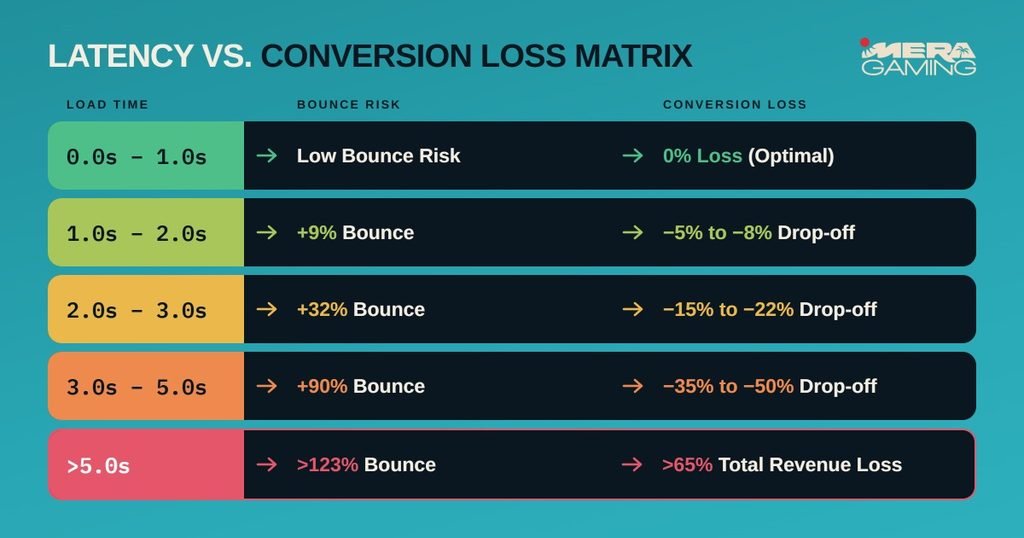
Any latency during page rendering introduces cognitive doubt. It’s a delay that opens the door for users to hit the back button and click a competitor’s link instead.
The Physics of Latency: Why Milliseconds Directly Impact Revenue
Page load performance is directly tied to server architecture, asset optimization, and DOM (Document Object Model) complexity.
When a browser requests an affiliate review page, it must parse HTML, execute JavaScript, render CSS, and load external tracking pixels. It’s a complex sequence where every millisecond counts.
In affiliate marketing, third-party tracking scripts (like impression tags, analytics suites, and dynamic link cloakers) frequently cause problems. They’re major culprits behind critical render-blocking bottlenecks.
A landmark global study by Deloitte and Google, titled Milliseconds Make Millions, analyzed millions of mobile sessions. They wanted to quantify the exact financial impact of site performance.
The findings are clear: a mere 0.1-second (100-millisecond) improvement in mobile load speed directly increased retail conversion rates by 8.4%. At the same time, it elevated average order value and user engagement by 9.2%.
In the high-frequency iGaming market, user acquisition costs are exceptionally steep. Failing to optimize load times by even a fraction of a second leads to massive capital leakage.
Engineering Core Web Vitals for iGaming Review Pages
To achieve optimal organic rankings and maintain conversion efficiency, webmasters must engineer their websites to meet Google’s strict Core Web Vitals thresholds:
- Largest Contentful Paint (LCP): Target <1.8s. LCP measures how long it takes for the primary content block to render completely. That’s typically the hero banner with your main casino offer and bonus CTA. To optimize LCP, affiliates should serve hero graphics in lightweight WebP or AVIF formats. It’s also vital to implement aggressive server-side caching. Finally, use Edge Content Delivery Networks (CDNs) so you’ll reduce time-to-first-byte (TTFB).
- Interaction to Next Paint (INP): Target <200ms. INP measures overall page responsiveness. It evaluates how fast a page responds when users click interactive elements, like filter buttons on a casino comparison matrix or dropdown menus. Heavy JavaScript execution is the primary cause of poor INP. To fix this, you’ll need to defer or eliminate unneeded scripts.
- Cumulative Layout Shift (CLS): Target <0.1. CLS quantifies visual stability. In affiliate site design, it usually happens when dynamic ads, un-dimensioned images, or late-loading web fonts cause text and CTA buttons to jump unexpectedly. Imagine a player trying to click ‘Read Review’ who accidentally hits an unintended banner due to a layout shift. They’ll experience immediate frustration. That’s a quick path to high bounce rates and ruined trust.
Technical UX/UI Framework for High-Converting Casino Pages
Creating a high-converting user interface requires balance. You’re balancing aesthetics, information density, and psychological momentum.
Users navigating casino review sites fall into two main groups. First, there’s skimmers looking for immediate bonus values and deposit links. Second, there’s analyzers seeking detailed breakdowns of licensing, game providers, and withdrawal limits.
An advanced UX/UI framework must serve both personas simultaneously. It’s all about delivering detail without cluttering the screen.
The Architecture of the Above-the-Fold (ATF) Area
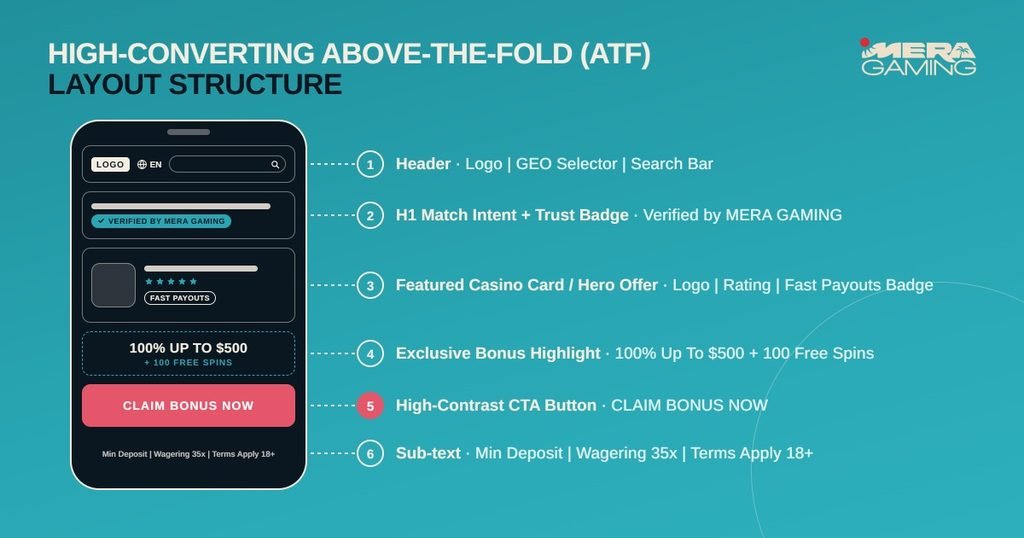
The Above-the-Fold (ATF) region is the area visible before a user scrolls down. It’s your most valuable digital real estate. Heatmapping data shows that over 57% of total viewing time happens above the fold. There’s a steep drop in engagement as users scroll deeper down the page.
- Clear Value Proposition: The primary header (H1) must explicitly match the user’s search intent, confirming GEO relevance immediately (e.g., “Top Regulated Online Casinos in Sweden”).
- Immediate Primary CTA: The highest-converting casino offer should be visually prominent within the first 400 vertical pixels. The CTA button must use high-contrast color palettes that stand out clearly from the background design.
- Essential Terms Visibility: Transparency builds immediate trust. It’s essential to display core bonus conditions directly beneath the CTA button, like minimum deposits, wagering requirements (e.g., 35x), and age restrictions (18+). Don’t hide bonus terms in tiny, unreadable footers. Doing so creates skepticism and drives up user bounce rates.
Mobile-First UI Engineering and Hick’s Law Application
Up to 75% of global iGaming affiliate traffic comes from mobile devices. Because of this, desktop-first design strategies are completely obsolete. Mobile layouts require precise execution. It’s where most of your audience lives, so they’re expecting a seamless mobile experience:
- Tap Target Sizing: CTA buttons, navigation menus, and filter toggles must adhere to a minimum size of 48×48 pixels with adequate padding. This eliminates accidental taps and navigational friction on smaller touchscreens.
- Let’s look at Hick’s Law: It states that decision time increases with the number and complexity of choices you present. If you show a visitor a list of 50 unsorted casino brands, you’re creating choice paralysis. It’s a quick way to make users abandon the site without clicking anything. High-converting UI designs limit primary comparison matrices to 3 to 5 curated choices. You’ll want to use helpful badges (like ‘Best Overall‘, ‘Fastest Payout’, or ‘Highest Bonus‘) to guide their decisions effortlessly.
Establishing Casino Site Authority: E-E-A-T and Trust Triggers
In an industry historically prone to spam and deceptive marketing, modern players are highly cautious. They’re careful about where they create accounts and enter payment details.
Building domain authority isn’t just an SEO requirement for ranking—it’s a fundamental conversion engine. When an affiliate portal radiates true credibility, users click outbound links with higher confidence and strong purchase intent.
Essential Trust Triggers for iGaming Affiliate CRO
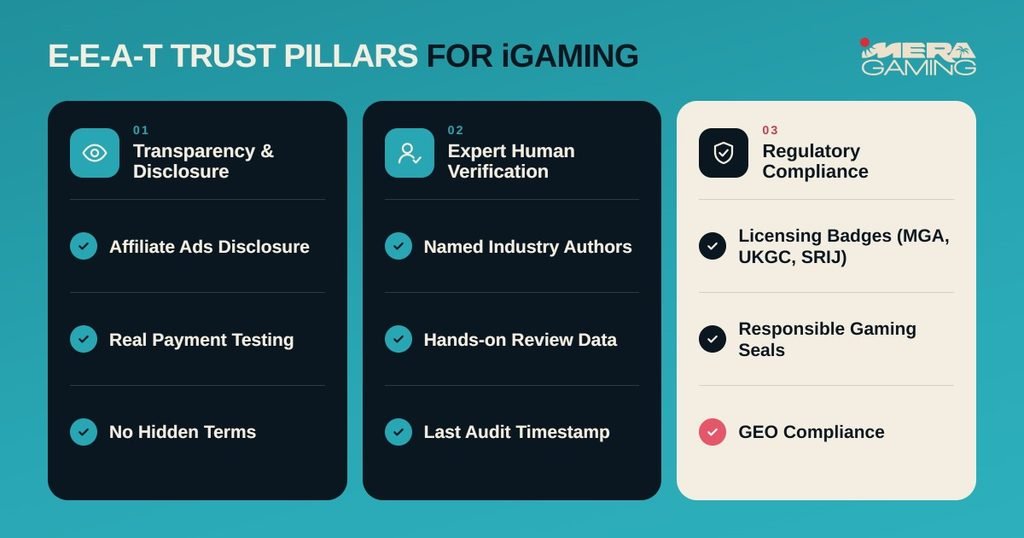
Integrating explicit trust signals directly into the user interface drastically reduces conversion friction. Affiliates must deploy key visual authority components strategically across their web pages:
- Regulatory and Licensing Seals: Display clear badges from recognized regulatory bodies, like the MGA, UKGC, or SRIJ. It’s best to place them prominently in page headers, review cards, and footers. These badges send immediate trust signals. They’ll reassure human users while showing Google’s quality crawlers that featured operators follow strict legal standards.
- Editorial Verification Timestamps: iGaming offers change rapidly; expired bonuses destroy credibility instantly. Incorporate dynamic timestamps indicating when the page and bonus terms were last audited (e.g., “Fact-Checked & Verified: October 2026”).
- Expert Author Attribution: In accordance with Google’s Quality Rater Guidelines, articles must be credited to real human experts with verifiable industry experience. Author bios should clearly detail hands-on experience in testing casino software, evaluating withdrawal speeds, and analyzing game mathematics.
- Affiliate Disclosure Integration: Transparency builds respect. It’s best practice to place a clear, concise affiliate disclosure statement near the top of the page (e.g., ‘We may receive compensation from the casino operators featured on this page when you click our links’). Doing this reassures users that your site operates with total integrity. That’s how you demonstrate full compliance with international advertising standards.
How to Target High-LTV Search Intent in iGaming SEO
Traffic volume without commercial intent is just a vanity metric. It inflates server costs without generating meaningful revenue.
A successful iGaming affiliate CRO strategy doesn’t just chase views. It relies on segmenting target keywords based on user psychological intent. By doing this, you’ll ensure that your high-value landing pages receive traffic primed for immediate conversion.
The Search Intent Revenue Spectrum
Search keywords in the online casino space fall into three main intent categories:
- Informational Intent (Low Conversion / Broad Top-of-Funnel): Take keywords like ‘how to play blackjack’ or ‘history of slot machines’. Users searching these terms want education, not real-money play. Trying to monetize this traffic through direct affiliate links won’t yield strong conversion rates. They’re simply not ready to deposit yet. Instead, it’s best to use informational content to build site architecture, earn organic backlinks, and internally link to your commercial pages.
- Commercial Investigation (Medium-High Conversion / Middle-of-Funnel): Consider keywords like ‘best online casino payout methods‘ or ‘Mr Green vs LeoVegas‘. Users searching these are actively evaluating options and comparing features. They’re right on the edge of making a choice. High-converting comparison tables and detailed feature breakdowns work exceptionally well here. It’s how you’ll convert this high-evaluation intent into actual sign-ups.
- Transactional Intent (Maximum Conversion / Bottom-of-Funnel): Then there are transactional keywords like ‘No Deposit Bonus Code [Brand]‘ or ‘fastest withdrawal casino real money Sweden‘. Here, the searcher has already decided to play. They’re just looking for the fastest path to register and activate their bonus. Pages targeting these keywords need streamlined layouts, high-contrast CTAs, and zero fluff. It’s all about eliminating friction so nothing is standing between them and the sign-up form.
Comprehensive CRO Performance Matrix for iGaming Affiliates
To monitor, diagnose, and continuously optimize an affiliate site for maximum conversions, your engineering and marketing teams need clear benchmarks. It’s not enough to track generic metrics. You’ll want to evaluate specific technical indicators against established industry standards. That way, there’s no guesswork when pinpointing performance bottlenecks and driving continuous CRO improvements.
| Metric | Metric Category | Optimal Target Threshold | Revenue & Conversion Impact |
| First Contentful Paint (FCP) | Technical SEO / Speed | <1.2seconds | Prevents initial session bounce before visual elements render. |
| Largest Contentful Paint (LCP) | Core Web Vitals | <1.8seconds | Ensures primary casino offer banner renders immediately, maintaining user intent. |
| Interaction to Next Paint (INP) | Core Web Vitals | <200milliseconds | Guarantees instant feedback on interactive comparison matrices and filters. |
| Outbound Click-Through Rate | Conversion (CRO) | $> 15\% – 25\%$ | Directly increases the volume of pre-qualified traffic sent to operator landing pages. |
| Mobile Tap Target Padding | UX / UI Design | Minimum 4848px | Eliminates misclicks, reducing user frustration and form abandonment on mobile devices. |
| E-E-A-T Trust Score Elements | On-Page Authority | $100\%$ Compliance | Increases user willingness to register and deposit, driving higher player LTV. |
iGaming Affiliate CRO Technical Checklist
To systematically upgrade your affiliate site’s UX/UI and maximize your overall conversion rates, execute the following step-by-step technical checklist:
- Optimize Server Infrastructure and Edge Caching: Migrate hosting to dedicated edge networks (e.g., Cloudflare Enterprise, AWS CloudFront) to achieve sub-100ms Time-To-First-Byte (TTFB) globally.
- Implement Lazy Loading and Modern Image Compression: Convert all visual assets to AVIF or WebP formats. Set explicit width and height attributes on all image tags to prevent Cumulative Layout Shift (CLS), and defer off-screen images using native lazy loading.
- Eliminate Render-Blocking Third-Party Scripts: Audit analytics and tracking pixels. Asynchronously load non-critical JavaScript or execute tracking tags via Server-Side Google Tag Manager to keep the main browser thread clear.
- Redesign Above-the-Fold UI for Mobile Screens: Ensure the top-performing casino offer, dynamic bonus text, key terms (18+, wagering requirements), and a high-contrast CTA button are fully visible on a 375px-wide mobile screen without requiring vertical scroll.
- Apply Hick’s Law to Comparison Matrices: Cap initial table displays at 3 to 5 featured operators. Utilize clear badges to highlight unique selling points (e.g., “Fastest Payouts”, “Highest Bonus”).
- Deploy Explicit E-E-A-T Trust Signals: Add verified author boxes with industry credentials, dynamic fact-checking timestamps, active regulatory license seals, and a prominent affiliate disclosure near the top of every review page.
- Perform Monthly Mobile Usability Audits: Continuously test user journeys on physical iOS and Android devices, ensuring that all tap targets, CTA buttons, and disclosure links function flawlessly across various screen resolutions.
Unlock High-LTV iGaming Offers to Boost Your ROI
Driving high-intent traffic is only half the battle. Sending that traffic to top-converting, highly trusted operators is what transforms clicks into long-term profit.
At MERA GAMING, we’ll help you turn those clicks into revenue. We partner with webmasters, media buyers, and affiliate networks to deliver exclusive, high-converting iGaming offers.
You’ll get transparent real-time tracking, flexible CPA and RevShare models, and dedicated account management tailored to global regulated markets. It’s everything you need to scale your performance with complete confidence.