Today’s digital entertainment market is hyper-competitive. For Heads of Growth and C-level executives, the single biggest operational challenge in 2026 is scaling an iGaming operator while preserving healthy profit margins. Global media buying costs continue to escalate. Local regulatory frameworks are tightening rapidly. In this environment, driving acquisition volume without strict financial discipline quickly erodes Net Gaming Revenue (NGR). To achieve sustainable, long-term expansion, operators must transition away from vanity metrics such as gross volume and top-line FTDs (First Time Depositors). Instead, scaling efficiently requires a structured strategy built around risk management, optimized affiliate commission models, and strict traffic qualification.
1. The Trap of Blind Expansion: Why Scaling Often Destroys iGaming Margins
Scaling an iGaming platform is rarely a linear equation where doubling acquisition spend means to double the net profit. In reality, aggressive scaling without operational guardrails often reduces margins through three core pain points.
The Exponential Rise of Direct Media Buying CAC
Relying heavily on direct PPC, programmatic ads, and paid social channels exposes operators to intense bidding wars for competitive keywords. As multiple brands fight for the same target user in premium markets, Customer Acquisition Cost (CAC) rises faster than the player’s projected Lifetime Value (LTV). Put simply: operators spend more to acquire a player than that player will ever deposit.
Hidden Operational Overhead: Payment Fees, Taxes, and Platform Costs
Top-line Gross Gaming Revenue (GGR) can be deceiving. Before an operator reaches bottom-line profitability, substantial deductions occur:
- Payment Service Provider (PSP) Fees: Processing charges for deposits and rapid payouts across localized payment methods.
- Local Taxes & Licensing: Gaming taxes on player activity in regulated jurisdictions.
- Platform & Game Provider Royalties: Percentage cuts deducted directly from monthly gaming revenues.
When we combine these fixed and variable costs with high initial CAC, high-volume months can result in margin compression or even losses.
Traffic Fraud and Baseline Manipulation
Unqualified traffic remains one of the largest drains on operator margins. Malicious actors and low-quality traffic sources often manipulate low deposit baselines to claim high Cost Per Acquisition (CPA) payouts. Without strict traffic filtering, operators end up paying premium acquisition fees for non-retained, single-deposit players or bot accounts.
2. Restructuring Affiliate Models: Balancing CPA, RevShare, and Hybrid Deals
Affiliate marketing remains the most cost-effective and scalable channel in iGaming, provided the commercial agreements align incentives between the operator and the traffic partner.
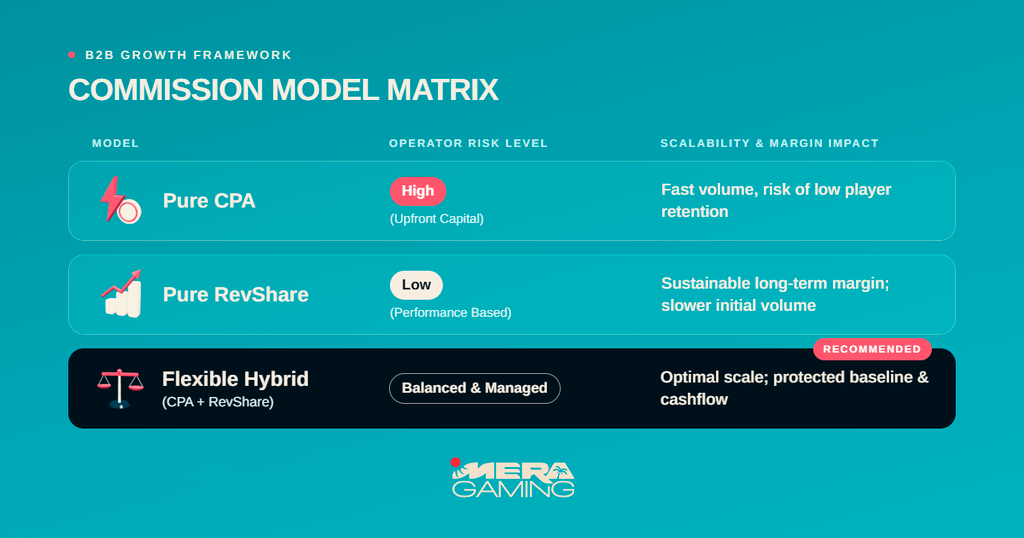
The Vulnerability of Pure CPA in High-Inflation Markets
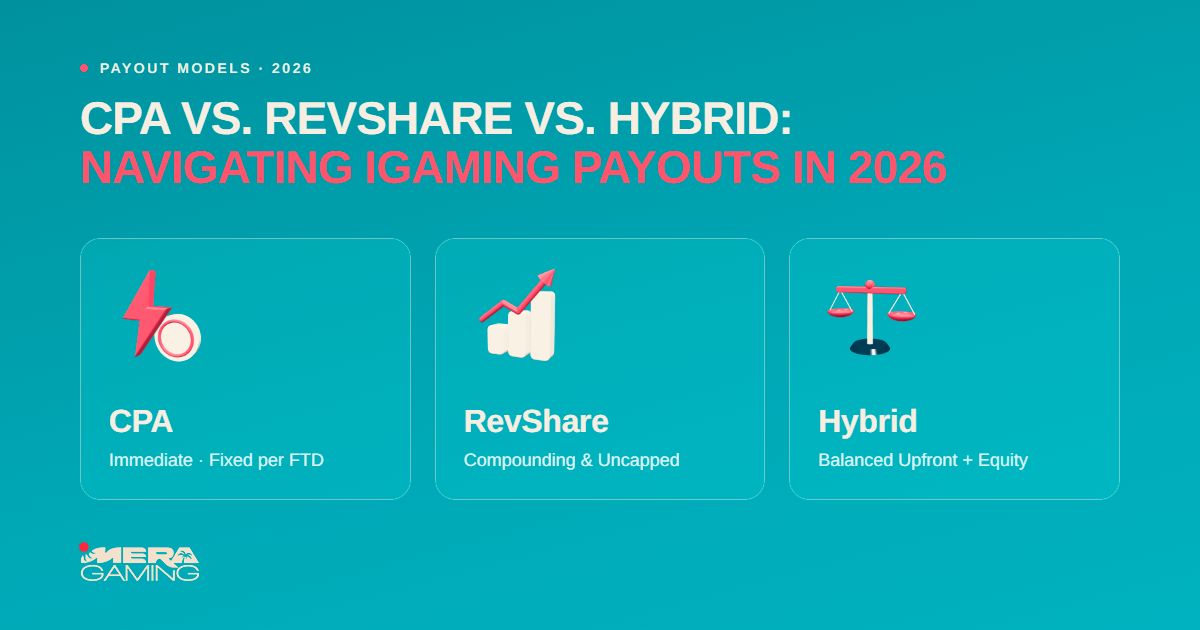
Offering aggressive pure CPA deals brings instant registration spikes, but it forces the operator to absorb 100% of the upfront financial risk. If the acquired players do not convert into recurring depositors, the operator incurs a net loss on every single user.
The Power of Flexible Hybrid Agreements
Opting for an hybrid structure (combining a modest upfront CPA with a long-term RevShare percentage) spreads the risk between the operator and the affiliate.
- The upfront CPA component covers the affiliate’s immediate media-buying overhead.
- The RevShare component ensures the affiliate has a financial incentive to to send high-value, long-term players.
To safeguard profitability, operators must enforce customized baseline criteria (e.g., minimum wagering requirements or multi-deposit triggers) before CPA payouts are paid.
Aligning Revenue Share with Real Net Gaming Revenue (NGR)
When negotiating RevShare models, transparency regarding the NGR calculation formula is essential. A healthy commercial contract must clearly define permissible deductions (such as active player bonuses, chargebacks, game provider fees, and tax deductions), ensuring payouts are calculated strictly on actual net profits generated.
3. Operational Efficiency: Internal Management vs. Specialized Affiliate Networks
Managing thousands of direct affiliate relationships in-house demands significant resource allocation, including dedicated affiliate managers, compliance officers, and specialized tracking software infrastructure.
The Cost of Over-Expanded In-House Teams
Building an extensive internal team to manage individual long-tail affiliates often inflates fixed operational overhead. Smaller affiliate partners often demand custom terms, constant support, and manual payout processing, consuming valuable internal bandwidth without delivering proportionate revenue impact.
Pre-Filtered Traffic and Risk Mitigation via Partner Networks
Partnering with established affiliate networks like MERA GAMING allows operators to streamline acquisition. Specialized networks pre-screen traffic sources, monitor compliance, eliminate fraud, and aggregate volume into a single managed pipeline. This enables operators to maintain lean internal operations while accessing high-volume, pre-qualified player flows across diverse markets.
4. GEO Optimization: Balancing Mature Markets with Emerging Horizons
Achieving margin stability requires strategic geographic diversification. As the recent Brazil ban showed us, operators cannot rely solely on a single region or maturity level.
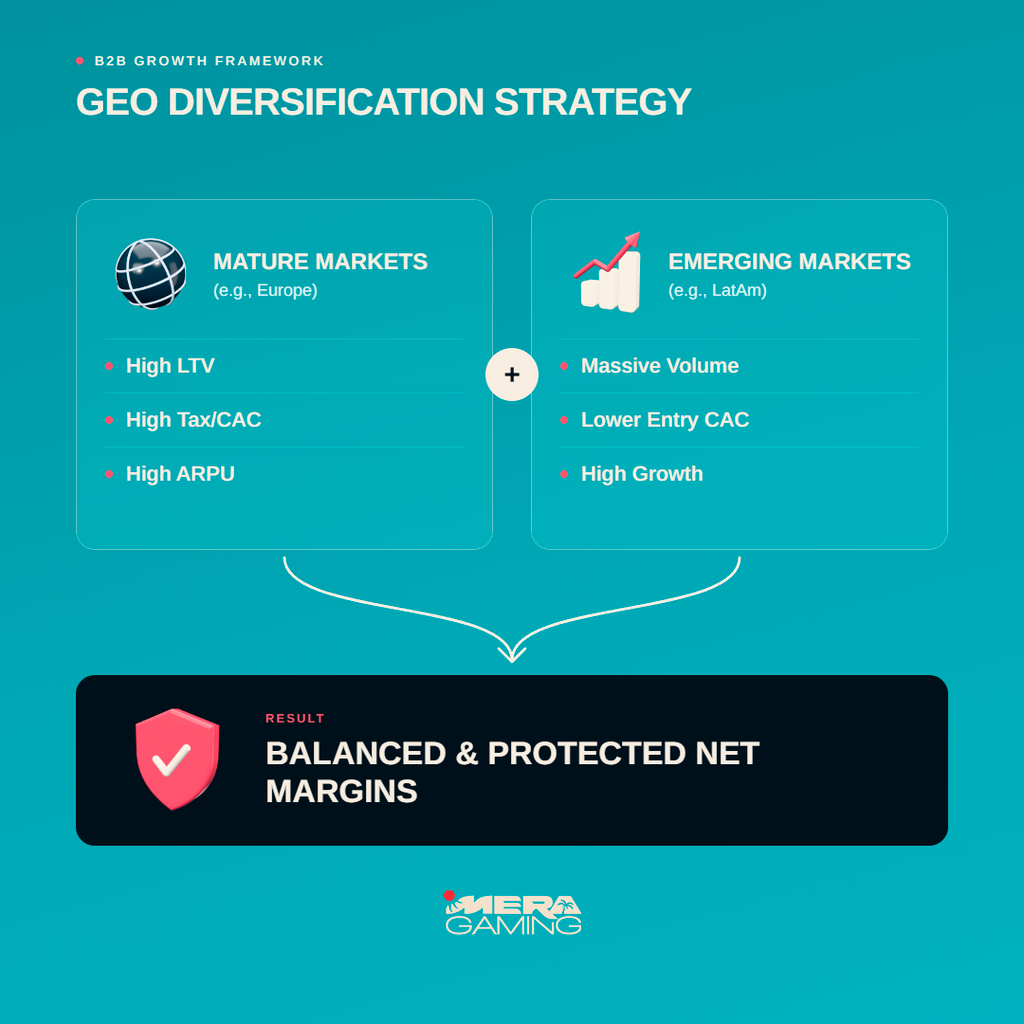
Diversifying Portfolio GEOs
- Established / Regulated GEOs: European markets typically feature high Average Revenue Per User (ARPU) and strong player LTV. However, elevated compliance costs, license fees, and gaming taxes reduces drasticaly net margins.
- Emerging Opportunities: Regions such as Latin America and selected African jurisdictions brings rapid player adoption, lower media acquisition costs, and a large volume potential. A strategy that mixes high-margin volume from emerging markets with high-LTV stability from mature GEOs protects operator’s overall cash flow.
Optimizing Funnel Conversion Rates Without Increasing Ad Spend
Improving page loading speeds, localizing user onboarding flows, and integrating regional payment methods (e.g., Mercado Pago in Argentina) directly increases conversion rates (CR). Boosting conversion efficiency allows operators to scale active player numbers without spending an additional dollar on traffic acquisition.
5. Retention Engineering: Maximizing LTV to Protect Margin
Acquisition brings players through the door, but retention is what sets the final profit margin. A 5% increase in player retention can dramatically impact overall profitability.
Automated Lifecycle Marketing & CRM Integration
Affiliate acquisition must be paired with automated, event-triggered CRM sequences. Tailored onboarding communications, localized loyalty rewards, and personalized re-engagement campaigns maximize lifetime wagering activity, reducing the need for costly continuous acquisition campaigns.
Anti-Churn Protection in the First 30 Days
Statistics across the industry show that the vast majority of player drop-offs occur within the first month post-registration. Implementing robust early-stage engagement workflows ensures that the initial cost paid to acquire the user translates into long-term NGR.
Conclusion & Strategic Next Steps
Scaling an iGaming operation without compromising margin requires a disciplined operational framework: flexible hybrid commission structures, rigorous fraud control, GEO diversification, and strategic partnerships. By shifting focus from top-line vanity volume to net revenue efficiency, operators can expand confidently in today’s evolving market.
Ready to Scale Your iGaming Operations Efficiently?
Partner with MERA GAMING to access high-quality, pre-qualified traffic and flexible commission models tailored to your platform’s growth targets.
To know how we can help operators scale volume while safeguarding net margins, fill out this form.