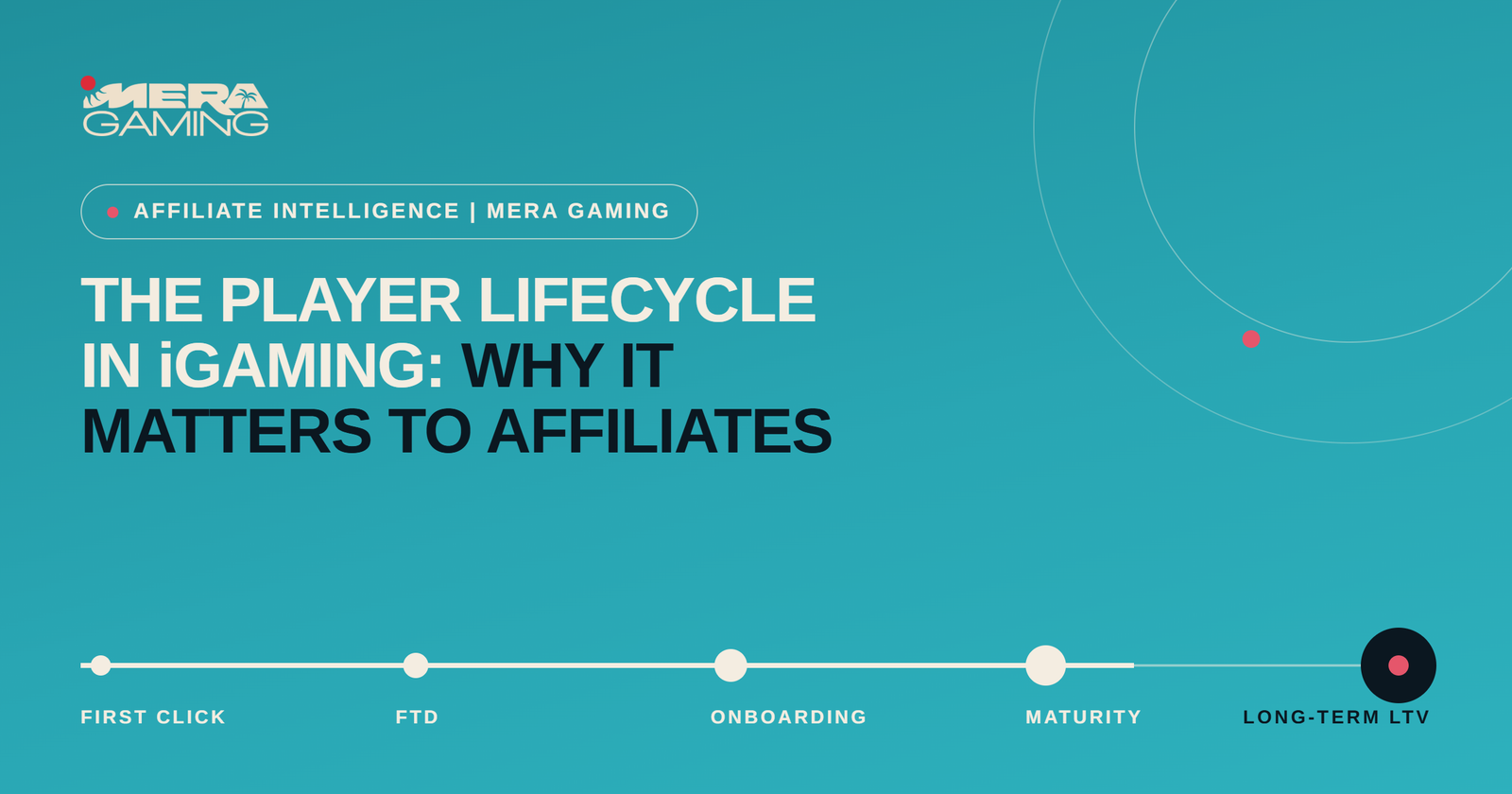
Acquiring a new player in the iGaming industry is only the starting point. While many affiliates focus exclusively on driving first-time depositors (FTDs), long-term profitability depends on what happens after the registration click. Understanding the player lifecycle is crucial for affiliate success, as it directly impacts revenue. This knowledge is one of the main factors that separates top-tier affiliates from those struggling with low payouts, daily caps, or cancelled campaigns.
Whether you operate on CPA, Revenue Share, or a Hybrid commission structure, the lifespan of your traffic defines your business value. To build a sustainable affiliate business, you must understand not only how players navigate their lifecycle, but also how operators perceive your traffic behind closed doors.
What Is the Player Lifecycle in iGaming?
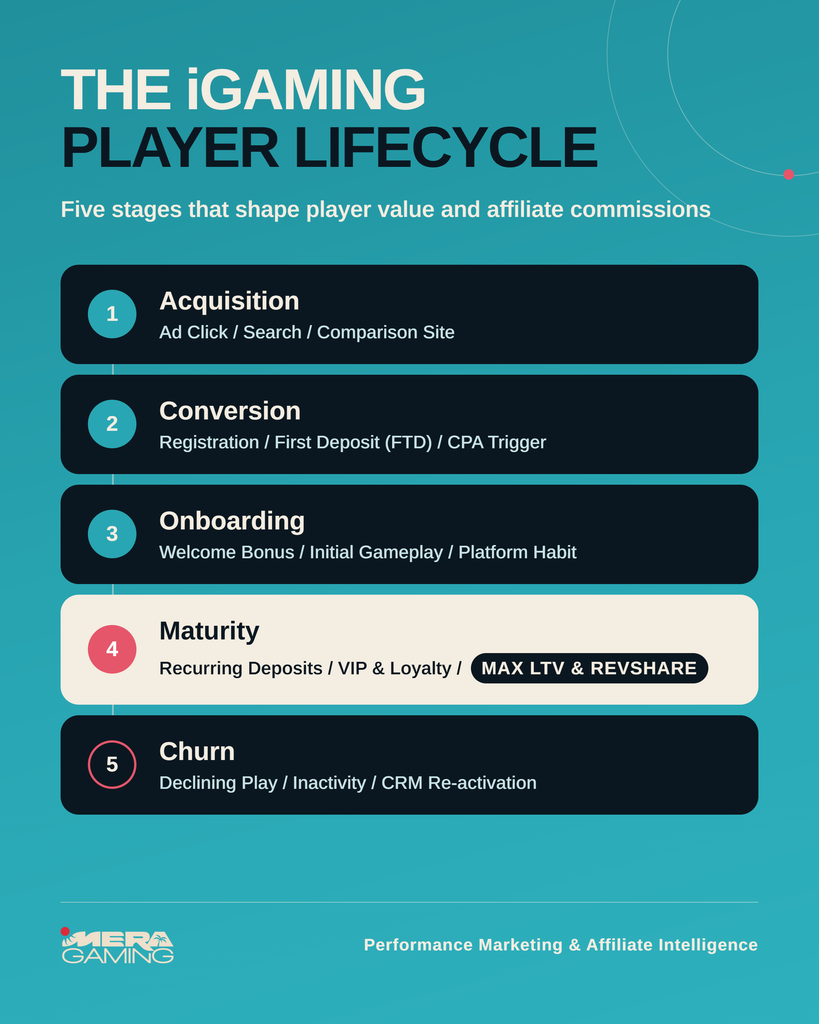
The player lifecycle represents the complete journey a user takes with an iGaming operator. It starts with their initial exposure to a marketing campaign and continues all the way to their final active gaming session. This journey consists of five distinct phases:
- Acquisition: The player finds your content, comparison site, or ad campaign and clicks through your affiliate link.
- Conversion: The user completes registration and makes their First Time Deposit (FTD).
- Early Onboarding & Engagement: The player explores the platform and uses welcome promotions. They then complete their initial gaming sessions.
- Maturity & LTV Accumulation: The user establishes a routine with regular deposits and activity. They participate in loyalty or VIP programs while generating Net Gaming Revenue (NGR).
- Churn & Inactivity: The player’s activity slows down until they become completely inactive or transition to another brand.
The Economics of iGaming: High CAC vs. Retention
The core economics of the iGaming industry rely heavily on retention. Fierce competition, high ad costs, and aggressive sign-up bonuses drive Customer Acquisition Costs (CAC) to high levels. As a result, operators rarely profit from a First Time Deposit (FTD) during the player’s first month.
In fact, an operator often incurs a net loss on a player in their first 30 to 60 days once marketing costs, payment processing fees, software provider royalties, and bonus costs are calculated. Profitability is only unlocked when players transition smoothly into phase 4, the Maturity stage.
How Player Lifecycle Impacts Affiliate Revenue Models
The lifetime of your traffic dictates your earnings. This applies to all standard deal structures:
1. Revenue Share Models
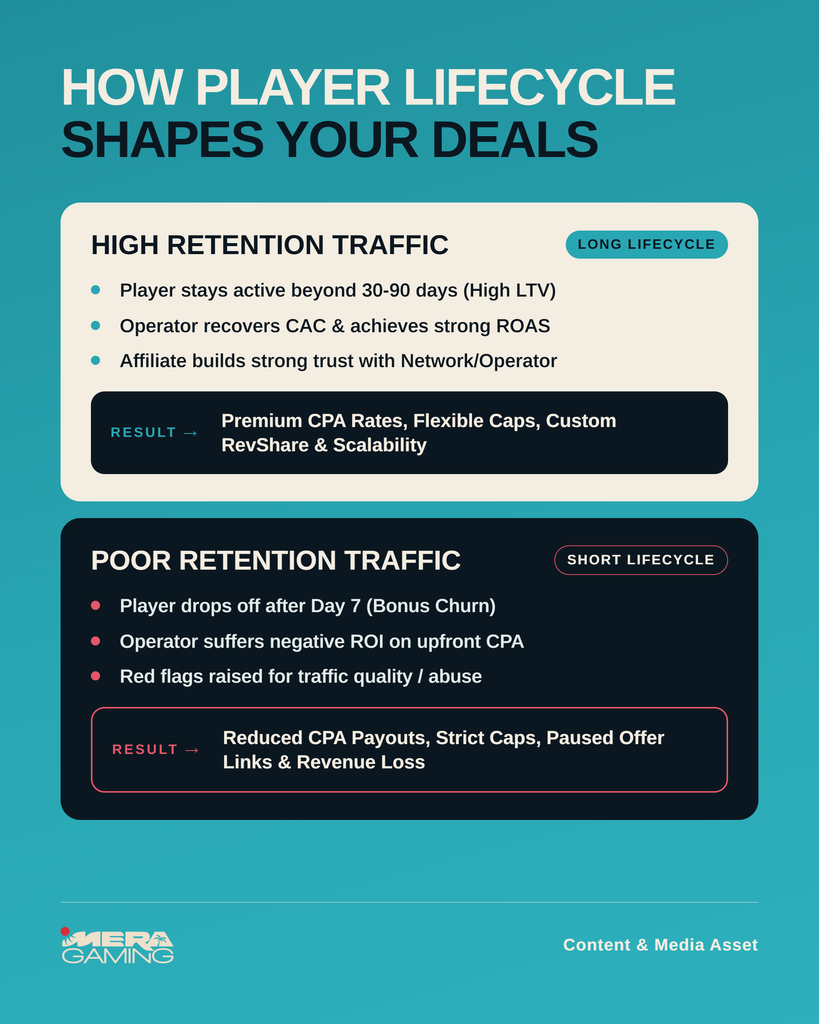
Under Revenue Share, your earnings are directly tied to the Lifetime Value (LTV) of the player. A player who remains active for 12 to 24 months generates recurring monthly commissions. Conversely, a player who churns after their first week yields virtually zero long-term return. This makes the acquisition effort unprofitable for affiliates.
2. CPA (Cost Per Acquisition) Models
In pure CPA deals, affiliates are paid upfront per qualified FTD. While it may seem like retention is purely the operator’s responsibility, operators constantly track cohort retention rates (at 30, 60, and 90 days) by traffic source.
If your traffic shows a short lifecycle or high churn rate, operators face severe negative margins. As a result, they will act fast by lowering your CPA rates, capping daily allocations, or cutting off the campaign entirely.
High-Retention Traffic ➔ High Player LTV ➔ Operator Profitability ➔ Higher CPA Caps & Exclusive Payouts
The Operator’s Perspective: What Happens When Player Lifecycles Fall Short?
To negotiate effectively with operators and affiliate networks like MERA GAMING, affiliates must look at metrics through an operator’s lens. When an affiliate delivers traffic with a short or weak lifecycle, operators identify critical operational issues:
1. Bonus Abuse and Fraud Signals
A player lifecycle that ends immediately after meeting the minimum FTD and bonus clearing requirements is a major red flag. Operators label this as bonus abuse or arbitrage. If a significant portion of an affiliate’s traffic exhibits this behavior, the operator may audit or withhold payouts pending investigation.
2. Unbalanced Return on Ad Spend (ROAS)
Operators set target payback periods (e.g., recovering CAC within 90 days). When player lifecycles end at day 14, the payback period becomes infinite. This forces operators to shift their budget away from the affiliate’s channel toward more reliable sources.
3. Misalignment of Marketing Intent
If players drop off rapidly, it often indicates a marketing mismatch. This usually means what the affiliate promised in their copy does not align with what the operator actually offers. Promising “guaranteed wins,” misleading bonus terms, or clickbait hooks leads to immediate player frustration and instant churn.
How the Player Lifecycle Influences the Operator-Affiliate Relationship
A healthy affiliate partnership relies on mutual profitability. When affiliates actively optimize for long-term player lifecycles, the business relationship transitions from transactional to strategic:
- Data Transparency: Operators are far more willing to share key insights with high-retention affiliates. This includes post-conversion data, cohort reports, and game preference details.
- Leverage for Custom Deals: Demonstrating strong 60-day retention gives affiliates significant leverage. It allows them to demand higher CPA payouts, custom baseline requirements, or hybrid revshare models.
- Campaign Longevity: Instead of jumping from offer to offer due to sudden pauses, high-retention affiliates enjoy stable, long-term cap allocations.
How Affiliates Can Optimize for Longer Player Lifecycles
If you want to increase the LTV of your traffic and strengthen your standing with operators, implement these practical strategies:
- Target Search Intent Over Impulse: Organic search traffic (SEO) and focused review sites consistently produce longer lifecycles than low-intent push notifications or deceptive social media ads.
- Be Transparent About Offers: Accurately explain wagering requirements, bonus terms, and game selections in your content. Setting correct expectations upfront reduces early player drop-off.
- Analyze GEO-Specific Behaviors: Player retention dynamics vary significantly by geographic region due to local economic factors, regulatory frameworks, and payment preferences. Match your offers to GEO-specific behaviors.
- Partner with Brands That Have Strong CRM: Your job is to bring qualified traffic; the operator’s job is to keep them. Choose operator partners known for aggressive retention marketing, VIP management, localized payment methods, and automated re-engagement funnels.
How MERA GAMING helps you meet operator expectations.
Understanding and optimizing for the player lifecycle is the key to scaling your iGaming affiliate operations sustainably. By aligning your traffic strategy with operator profitability, you secure higher payouts, dedicated account management, and reliable income streams.
At MERA GAMING, we partner with top-tier operators featuring proven CRM pipelines, transparent tracking, and competitive payout structures tailored to your traffic profile.
Ready to scale your iGaming campaigns with long-term, high-converting offers? Register as a MERA GAMING affiliate today or reach out to your dedicated account manager by clicking the button below: