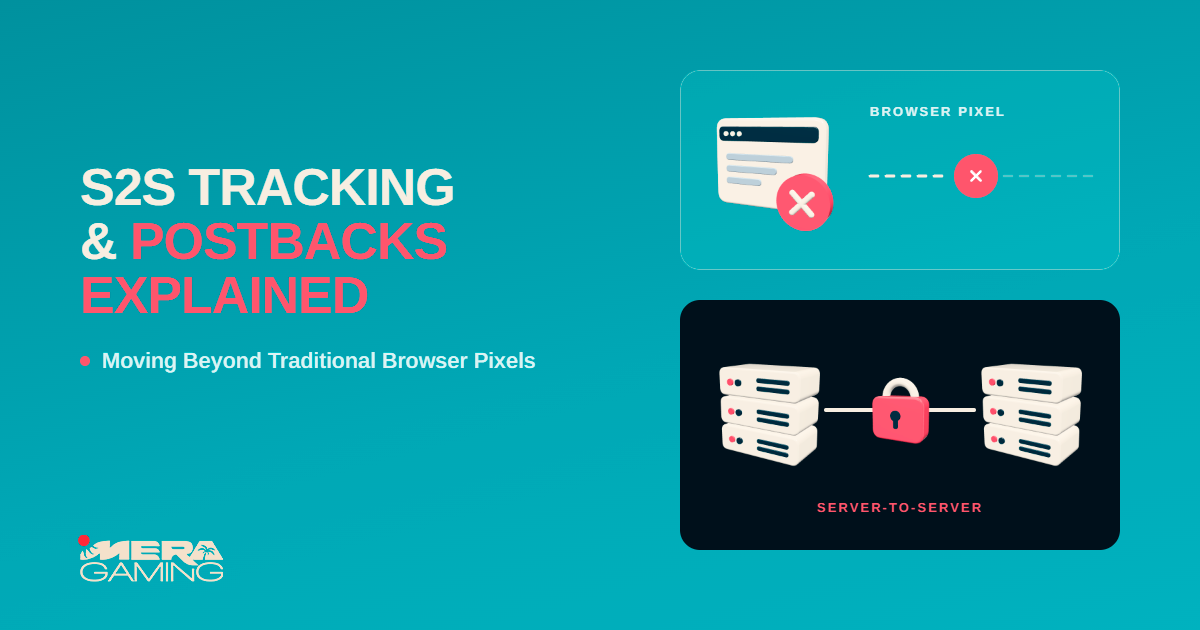
S2S tracking and postbacks are the gold standard for conversion attribution in modern iGaming affiliate marketing. They replace vulnerable client-side browser pixels with secure, server-to-server HTTP requests. For media buyers, webmasters, and operators navigating strict privacy updates and aggressive ad blockers, moving beyond traditional cookies is no longer optional. It’s a financial necessity to avoid losing up to 30% of conversion tracking.
In the fast-paced iGaming ecosystem, every single click, registration, and First Time Deposit (FTD) holds significant monetary value. Yet, outdated attribution setups quietly cost millions of euros in affiliate commissions every month.
If your marketing strategy still relies on traditional HTML pixels or third-party JavaScript tags firing in a player’s browser, your data pipeline is compromised. This comprehensive guide breaks down the technical mechanics of Server-to-Server (S2S) tracking. It explains why traditional pixels are failing and shows how robust postback URLs protect your ROI across global iGaming markets.
The Anatomy of Conversion Attribution: Client-Side vs. Server-Side
To understand the industry shift, we must examine how client-side tracking (pixels) and server-side tracking (S2S postbacks) differ architecturally.
How Traditional Pixels Work (Client-Side)
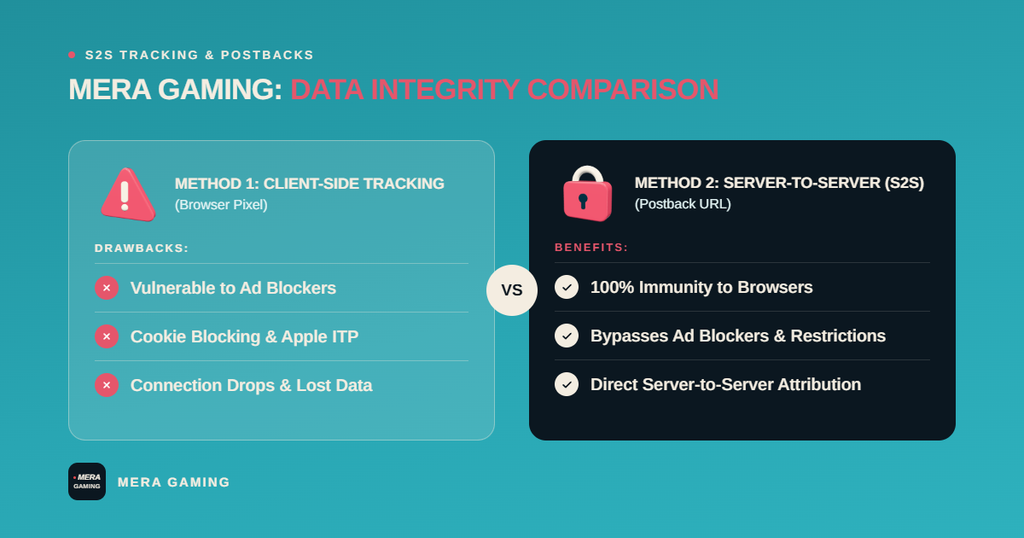
Client-side tracking relies entirely on the user’s web browser to execute code and report conversions.
- A potential player clicks on an affiliate review link.
- The user’s browser stores a third-party cookie containing attribution parameters.
- Upon completing a conversion (e.g., reaching a “Thank You” page after depositing), a 1×1 transparent image tag or a JavaScript snippet executes inside the browser.
- The browser sends a signal back to the affiliate platform confirming the event.
Because this process happens on the “client” side, it is fully dependent on the browser remaining open, accepting cookies, and executing external scripts without interference.
How S2S Tracking and Postbacks Work (Server-Side)
Server-to-Server (S2S) tracking eliminates the user’s browser from the conversion reporting loop entirely.
- When a user clicks an affiliate link, the tracking platform generates a unique parameter, commonly known as a Click ID (or subid).
- The click ID is passed dynamically to the operator’s landing page URL and stored in the operator’s database upon registration.
- When the player makes a deposit, the operator’s backend server initiates an automated, encrypted HTTPS request (a Postback URL) directly to the affiliate network’s server.
- The postback passes the unique Click ID alongside conversion metadata (transaction value, currency, event type), immediately crediting the affiliate.
Why Traditional Pixels Are Failing in Modern iGaming Marketing
The decline of client-side tracking is driven by structural shifts in web architecture, consumer behavior, and privacy regulations. Relying on browser pixels creates massive data discrepancies between operator databases and affiliate reports.
1. The Cookie Apocalypse & Apple’s ITP
Tech giants have systematically dismantled client-side tracking mechanisms to protect user privacy. Apple’s severely limits or completely blocks third-party cookies on Safari across iOS and macOS. With Safari commanding a dominant share of mobile traffic in tier-1 iGaming markets, pixel tracking fails to match conversions to the original click source, resulting in untracked sales.
2. Widespread Adoption of Ad Blockers
A significant portion of tech-savvy casino and sports betting audiences utilize ad blockers, script blockers, or privacy-focused browsers like Brave. Independent research reveals that between 20% and 40% of internet users block client-side tracking scripts. Because ad blockers identify and disable JavaScript pixels running in the DOM, legitimate conversions triggered by genuine player deposits are silently dropped.
3. Cross-Device and Delayed Conversion Journeys
The player acquisition funnel in iGaming is rarely linear. A user might click an affiliate ad on their mobile device while commuting, complete registration later on a desktop computer, and execute their first deposit three days later via a mobile banking app.
Browser cookies cannot survive cross-device switches or extended time gaps. S2S tracking solves this by anchoring the attribution to a permanent user account record tied to the initial Click ID in the operator’s database, ensuring zero loss of historical attribution.
S2S Tracking in iGaming: Fraud Prevention and Asynchronous Events
While accuracy and data retention are crucial across all e-commerce sectors, server-to-server tracking provides specific, indispensable advantages tailored to the iGaming industry.
Fraud Prevention & Tokenized Security
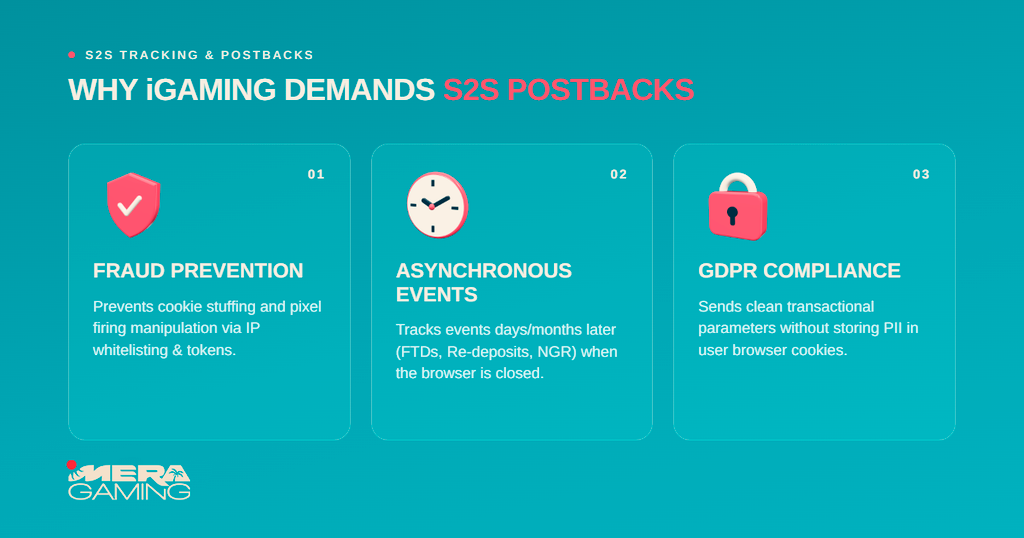
Client-side pixels are notoriously susceptible to malicious exploits, including cookie stuffing, automated script injection, and artificial conversion triggers. Dishonest actors can inspect page source code, isolate pixel endpoints, and fire fake conversion calls.
S2S postbacks mitigate this risk through robust backend security protocols:
- IP Whitelisting: Postback endpoints only accept incoming signals from verified operator server IP addresses.
- Secret Security Tokens: Every postback request carries a cryptographic token or hash string authentication header.
- Transaction ID Validation: Each reported conversion must match a valid, pre-existing Click ID generated by the tracking system.
Capturing Asynchronous Events (FTDs, Re-deposits, and RevShare)
In iGaming, the initial registration is rarely the primary payout event. Payout structures (whether under a CPA, Revenue Share, or Hybrid model) depend heavily on events that occur long after the initial click.
- First Time Deposits (FTDs): Often happen hours or days after registration.
- Re-deposits and Player Lifetime Value (LTV): Occur continuously over months or years.
- Net Gaming Revenue (NGR) Recalculations: Monthly commission adjustments based on player wins/losses.
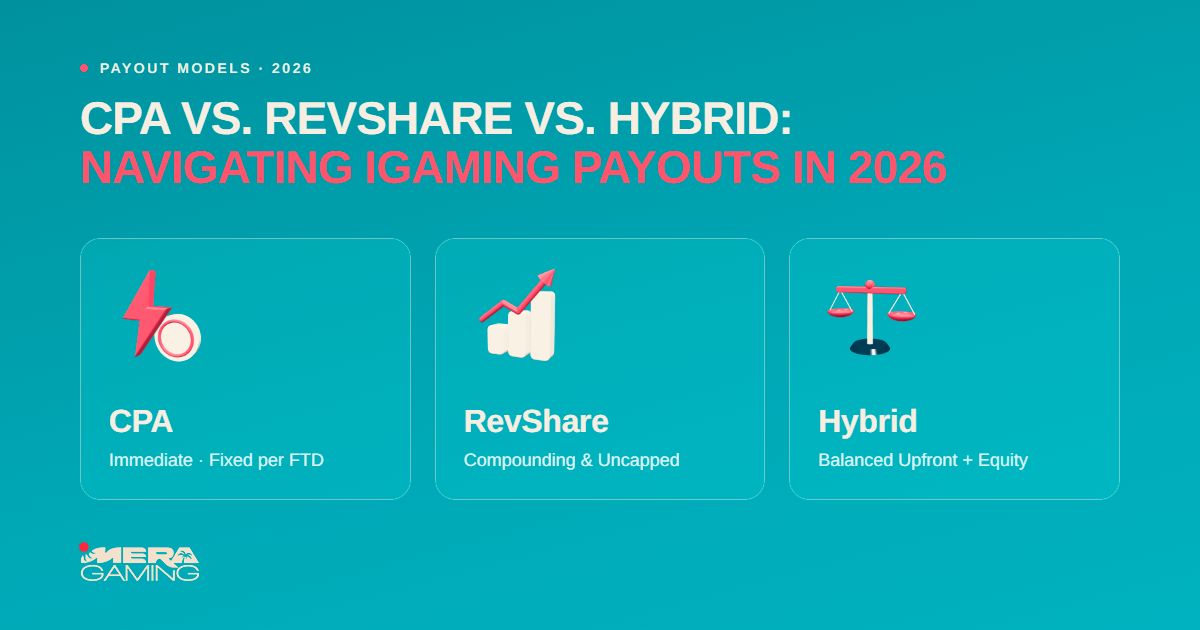
When a player redeposits three months after clicking an ad, their browser is closed, and the original session cookie has expired. A server-side postback URL seamlessly communicates this backend financial event to the affiliate network, updating the affiliate’s earnings in our dashboard without requiring any action from the user. For a deeper breakdown of payout mechanics, explore our guide on CPA vs RevShare models.
GDPR Compliance and Data Privacy
Under stringent global privacy frameworks like the European Union’s General Data Protection Regulation (GDPR), transmitting Personally Identifiable Information (PII) through browser URLs or client-side cookies poses severe legal risks. S2S postbacks pass anonymized, alphanumeric strings (e.g., click_id=987654321&payout=150¤cy=EUR), keeping personal player data safely insulated inside the operator’s secure database while fulfilling all attribution requirements.
Step-by-Step: How a Postback URL Loop Works
To implement S2S tracking effectively, affiliates and operators must establish a unified parameter-passing loop. Here is the exact technical execution flow:
Step 1: The Outbound Click
The user clicks an affiliate tracking link. The network attaches a unique identifier to the destination URL.
Affiliate tracking link example (not a real link):
https://operator-casino.com/register?btag=aff123&click_id=MERA_9988776655
Step 2: Parameter Capture
The operator’s landing page captures click_id=MERA_9988776655 and stores it in the player’s newly created database record upon account registration.
Step 3: Event Trigger & Server Postback
The player completes a qualification event (e.g., depositing €100). The operator’s backend server automatically executes an outbound HTTPS GET request to the MERA GAMING postback endpoint:
HTTP GET request example (not a real link):
https://engine.meragaming.com/postback?click_id=MERA_9988776655&event=FTD&payout=150.00¤cy=EUR
Step 4: Real-Time Credit
MERA GAMING’s server processes the request, matches MERA_9988776655 to the original media buyer, verifies the security hash, and immediately updates the affiliate’s balance.
Implementing S2S Tracking for Maximum Campaign Performance
Transitioning to S2S postbacks is the single most impactful optimization an iGaming affiliate can make to improve data accuracy and scale media buying operations.
To ensure seamless integration:
- Always Pass Dynamic Click IDs: Ensure your tracking platform (e.g., Voluum, RedTrack, Scaleo) is configured to insert dynamic tags (such as {clickid}) into your offer links.
- Test Postbacks in Staging: Prior to launching high-volume traffic in new geographic markets (GEOs), execute end-to-end postback tests with your affiliate manager to confirm parameter mapping.
- Audit Discrepancies: If you observe a variance greater than 1% to 2% between your ad network clicks and conversion reports, audit your setup to eliminate legacy browser pixels completely.
Conclusion: Securing Your Attribution Infrastructure
As the iGaming industry grows increasingly competitive, survival depends on data precision, security, and scalability. Relying on legacy browser pixels exposes media buyers and operators to silent revenue leakage, ad blocker disruption, and attribution fraud.
By embracing Server-to-Server (S2S) tracking and postback URLs, affiliates gain 100% data fidelity, complete immunity to client-side browser restrictions, and full visibility over long-term player LTV.
Ready to Scale Your iGaming Campaigns with 100% Tracking Precision?
At MERA GAMING, we empower our partners with cutting-edge S2S infrastructure, real-time reporting, high-converting exclusive casino offers, and dedicated account management. Stop losing commissions to outdated tracking methods.
👉 Join the MERA GAMING Affiliate Program today or Contact Our Commercial Team to optimize your attribution setup and maximize your campaign ROI.